The Seedox Attack Chain and Execution Mechanics
The operational framework of Seedox is divided into distinct execution phases designed to ensure persistence, evade detection, and maximize data collection. Analyzing this step-by-step progression reveals how commodity infostealers transition from initial access to irreversible asset exfiltration.
Initial Access and Delivery Mechanisms
Because Seedox is distributed as an underground builder, individual threat actors deploy varying initial access vectors depending on their target demographics. Common delivery channels include search engine optimization poisoning, masquerading as critical software updates, and embedding the payload in trojanized desktop utilities. Once a user executes the initial loader, the malware quietly initializes in the background without displaying graphical interfaces or spawning noticeable windows. Additionally, some variants implement removable media propagation, copying malicious shortcut files to connected USB drives to spread laterally within isolated business networks.
Local Execution and Anti-Analysis Safeguards
Upon initial execution, Seedox attempts to determine if it is running inside a virtualized sandbox or a debugger. The binary queries specific registry paths and searches for hypervisor artifacts associated with popular malware analysis environments. If no virtualized signatures are detected, the malware decodes its configuration parameters, which include the command and control server addresses, using layered decryption routines like Base64 combined with a custom XOR cipher. The payload then injects its core routines into legitimate system processes, minimizing its file footprint on the physical disk.
FileSystem Discovery and Drive Traversal
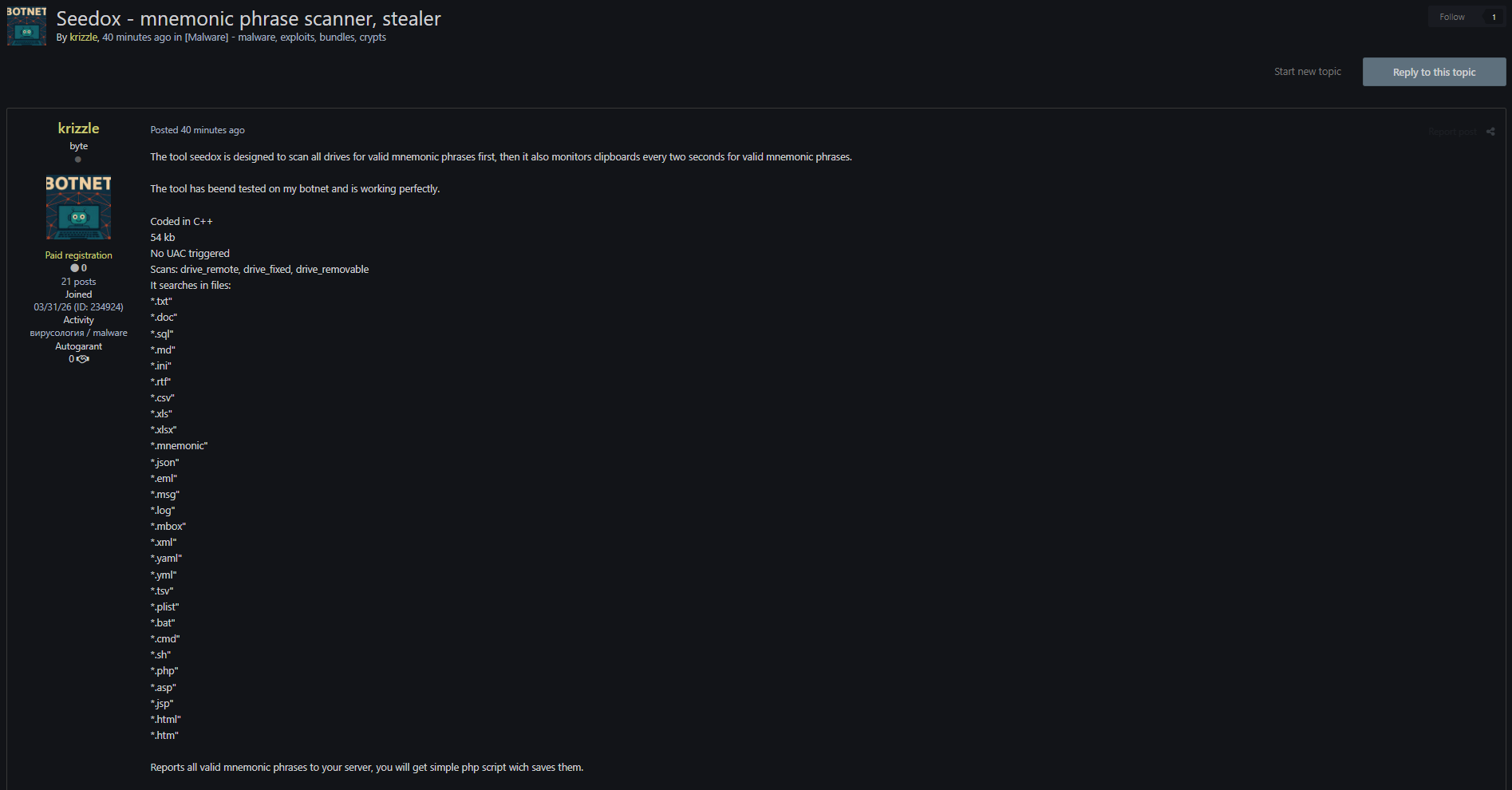
Once active, the malware initiates an exhaustive scan of the host's storage architecture. Using native Windows APIs, Seedox enumerates all active logical drives, paying close attention to removable storage devices and external backups. The file system traversal routines search recursively through directories, targeting common file extensions such as text files, Word documents, PDFs, and spreadsheets. When a target file is identified, the malware parses the contents looking for specific sequences of words that match the standard cryptocurrency mnemonic formats.
Active Clipboard Hijacking
Simultaneously, Seedox registers itself with the Windows Clipboard Chain, monitoring every clipboard transaction. When a user copies a string of text, the malware instantly intercepts the payload to determine if it matches a cryptographic address or a multi-word recovery phrase. If a match is verified, the malware can either log the recovery phrase for exfiltration or dynamically alter the copied address in memory. This address-swapping technique redirects outgoing blockchain transfers to the attacker's wallet, often without the user realizing the destination has changed until the transaction is finalized on the ledger.
Exfiltration and C2 Infrastructure Routing
The harvested credentials, wallet configurations, and intercepted clipboards are compiled into compressed, encrypted packages. Seedox utilizes multiple pathways to send this data back to its operators, relying on encrypted HTTP requests, Telegram API webhooks, or portable local proxy networks routed through the Tor network. By utilizing localized SOCKS5 proxy configurations, the malware masks its command and control traffic behind legitimate system connections, making detection via basic firewall logging exceptionally difficult.