Security Engineering and Behavioral Detection Logic
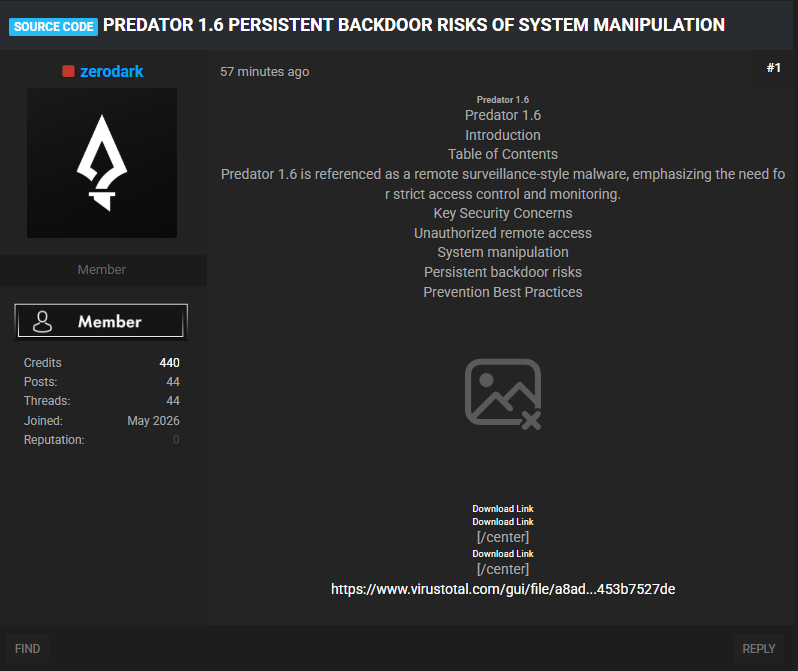
Relying solely on static file signatures is insufficient to defend against polymorphic stubs generated by the Predator 1.6 compiler. Security engineers must establish behavioral detection rules within their Endpoint Detection and Response (EDR) platforms to identify the specific execution patterns of file binders.
1. Identifying Double Extension Anomalies
Attackers frequently use double extensions to deceive users. Security teams should monitor process execution events where the file name ends with suspicious compound extensions. A sample query logic for identifying these events includes:
ProcessName SecurityEvent | where ProcessName endsWith ".pdf.exe" or ProcessName endsWith ".docx.exe" or ProcessName endsWith ".xlsx.exe" or ProcessName endsWith ".png.exe" | project TimeGenerated, Computer, Account, ProcessName, FolderPath
2. Monitoring Suspect Child Processes Spawning from Legitimate Applications
Another strong behavioral indicator of a file binder is when a benign application, such as a PDF reader or web browser, spawns a command shell or an unrecognized executable out of a temporary user-writable folder. Security teams should alert on the following pattern:
ParentProcessName == "AcroRd32.exe" or ParentProcessName == "chrome.exe"
ChildProcessPath startsWith "C:\Users\" and ChildProcessPath contains "\AppData\Local\Temp\"
3. YARA Rule for Detecting PE File Binders
The following YARA rule can be deployed across endpoint scanning tools to detect standard portable executable (PE) binders that contain multiple embedded files and use common APIs to drop and execute secondary payloads:
rule Detect_PE_File_Binder {
    meta:
        description = "Detects generic PE file binders dropping multiple executables"
        author = "FemtoSec Threat Intelligence"
        severity = "High"
    strings:
        $api1 = "WriteFile" ascii
        $api2 = "CreateFile" ascii
        $api3 = "GetTempPath" ascii
        $api4 = "ShellExecute" ascii
        $api5 = "WinExec" ascii

        $mz_header = { 4D 5A }
    condition:
        uint16(0) == 0x5A4D and all of ($api*) and #mz_header > 1
}
Enterprise Impact and Immediate Mitigation Steps
The availability of Remote Access Trojan source code poses significant threat vectors for corporate environments. Because these utilities bypass traditional detection, threat actors can establish long-term persistence within target networks, facilitating lateral movement and data exfiltration. Furthermore, compromised systems can be integrated into botnets or used as initial access vectors for ransomware groups. Organizations must adopt proactive measures to restrict the execution of untrusted files and validate their active defensive controls.