Water Infrastructure Authority Database Leaked Online
A threat actor claims to have leaked more than 100,000 records from a public water management entity, exposing Peruvian national identity document numbers, citizen names, emails, and internal complaint registries.
Key Takeaways
- A threat actor published over 100,000 records allegedly exfiltrated from the Peruvian public infrastructure agency Special Project Chavimochic.
- Exposed records include citizen and employee DNI national identity numbers, full names, emails, formal complaint filings, and internal project documents.
- The breach exposes Peruvian citizens to heightened spear-phishing, identity theft, and fraudulent administrative requests.
- Organizations must isolate database instances, audit web portal query logs, and enforce multi-factor authentication across all administrative access points.
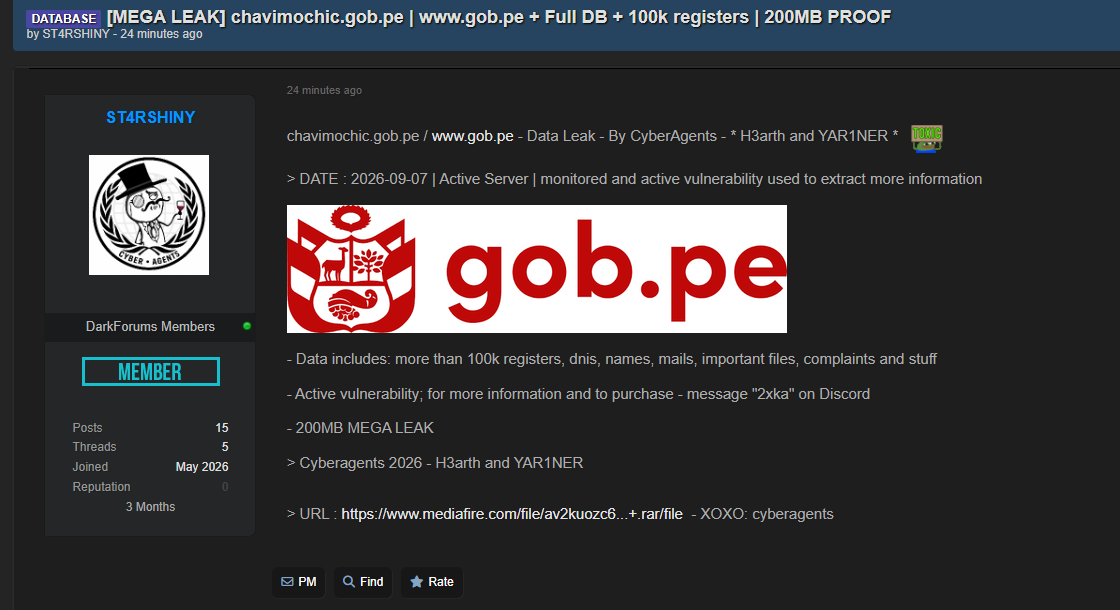
A database containing more than 100,000 records originating from the Peruvian public infrastructure agency Special Project Chavimochic has been posted on an underground cybercrime forum. The archive, totaling approximately 200 megabytes of structured data, reportedly encompasses sensitive personally identifiable information (PII) of citizens and personnel, including national identification document (DNI) numbers, full names, email addresses, internal documents, and formal public complaint records.
The targeting of regional infrastructure authorities highlights persistent vulnerabilities in public sector digital services, where web-facing administrative portals, public record submission forms, and backend relational databases are frequently exposed to automated scanning and credential reuse attacks.
Scope of Exfiltrated Assets
What Was Exposed
The threat actor claims to have obtained a full database export containing structured citizen records and internal workflow communications. The compromised dataset includes multiple categories of sensitive identity and administrative records:
National Identity Numbers: More than 100,000 citizen and employee Documento Nacional de Identidad (DNI) entries.
Personal Identifiable Information: Full names, personal and government email addresses, and contact records.
Citizen Complaints and Claims: Formal submissions logged through the entity's public complaint book (Libro de Reclamaciones) and documentation processing workflows (Trámite Documentario).
Internal Documentation: Administrative files, operational correspondence, and structural project records associated with regional hydraulic development operations.
The presence of government-issued identification numbers alongside full names and official correspondence makes this dataset particularly potent for secondary social engineering and unauthorized account recovery attempts.
How the Data Got Out
While the threat actor has not publicly published specific exploit tooling or proprietary initial access scripts, the attack pattern aligns with established threat actor tactics targeting public sector web portals across Latin America. Web applications operating on government subdomains frequently run legacy Content Management Systems (CMS), custom PHP portals, or exposed API interfaces that lack modern input validation.
Attack Chain Mechanics
Adversaries targeting public infrastructure databases typically execute a structured progression:
Reconnaissance (MITRE ATT&CK T1596): Scanning external public endpoints across
chavimochic.gob.peto identify exposed database ports (e.g., MySQL on TCP 3306, PostgreSQL on TCP 5432) or vulnerable web applications.Initial Access (MITRE ATT&CK T1190 or T1078): Exploiting public-facing web vulnerabilities, such as Structured Query Language Injection (SQLi) or Insecure Direct Object References (IDOR), or authenticating with compromised administrative credentials recovered from information-stealer malware logs.
Data Collection and Exfiltration (MITRE ATT&CK T1005 / T1567): Executing bulk export queries across database tables holding citizen submissions and administrative records, followed by staging and downloading compressed archive files over HTTPS or web services.
Impact (MITRE ATT&CK T1491 / T1485): Publishing the exfiltrated archives on illicit marketplaces to build underground reputation or facilitate subsequent extortion.
Proactive attack surface visibility is essential to catch these exposures before threat actors do. Organizations can evaluate exposed digital assets through continuous Attack Surface Management to detect misconfigured endpoints and open database services.
Compromise and Exfiltration Flow
- 1Reconnaissance
Port & web scanning on chavimochic.gob.pe
- 2Initial Access
Exploitation of web forms or stolen credentials
- 3Collection
Bulk database export of citizen PII & claims
- 4Impact & Leak
Publication on cybercrime forum
Downstream Risk
The downstream consequences of this breach extend beyond direct infrastructure disruption to serious individual identity exposure and organizational security risks.
Targeted Phishing and Spear-Phishing
Adversaries often weaponize leaked DNI numbers, verified email addresses, and names to design highly convincing spear-phishing campaigns. By referencing legitimate citizen complaint reference numbers or official infrastructure project names, malicious actors can impersonate regional government officials to target contractors, farmers, and municipal partners.
Identity Fraud and Account Takeover
In many administrative systems, a valid DNI number combined with full names and birth records serves as primary authentication or secondary identity verification for banking, municipal services, and telecommunications accounts. Stolen identity sets are frequently repurposed for synthetic identity fraud, unauthorized SIM swaps, or fraudulent social benefit claims.
Secondary Network Infiltration
Exfiltrated internal project files and administrative email trails often contain organizational charts, network naming conventions, server hostnames, and software versions. Threat groups actively analyze leaked public sector documentation to map internal network boundaries for follow-on access attempts.
Free exposure check
Dark Web Scanner
check dark web mentions, compromised account indicators, malware log signals, public breach exposure, and recent underground market activity for your domain.
Downstream Risk Radii
- Targeted Phishing & Spear-Phishinghigh
- Identity Fraud & Account Takeoverhigh
- Secondary Network Mappingmedium
- Regulatory & Compliance Penaltiesmedium
Regulatory and Notification Exposure
Public sector organizations handling personal citizen data must navigate stringent data protection and disclosure obligations following a confirmed unauthorized disclosure.
Data Protection Authority Reporting: Under national privacy frameworks (such as Peru's National Authority for Personal Data Protection / ANPDP under Law No. 29733), organizations must document security breaches, investigate the scope of unauthorized access, and implement mandatory remediation measures.
Citizen and Partner Notification: Affected individuals whose DNI numbers, complaints, and contact information were compromised should receive transparent breach notifications warning them of potential impersonation and phishing risks.
Critical Infrastructure Governance: Entities managing vital hydraulic and agricultural resources face heightened supervisory review to ensure core operational operational systems (OT/ICS) remain segregated from public-facing web networks.
Continuous monitoring across subterranean channels is vital for tracking exfiltrated assets. Implementing enterprise Dark Web Monitoring enables security teams to identify exposed company data, credential pairs, and internal documents the moment they surface on underground forums.
Adversary TTP Alignment (MITRE ATT&CK)
What to Check Now
Security teams managing public sector or enterprise portals should immediately execute verification, containment, and hardening protocols to protect database integrity and user identities.
Immediate Technical Verification Steps
Audit Relational Database Logs: Review database query logs for high-volume
SELECT *statements, table export commands (such asmysqldumporCOPY TO), and anomalous connections originating from untrusted public IP ranges.Inspect Web Server Access Logs: Analyze Apache, Nginx, or IIS logs for automated vulnerability scanning patterns, SQL injection payloads (e.g.,
UNION SELECT,SLEEP(), `' OR '1'='1`), and unauthorized calls to document management endpoints.Review Citizen Complaint Portals: Audit Access Control Lists (ACLs) and API authentication mechanisms protecting citizen submission forms, ensuring unauthenticated users cannot traverse records via predictable ID parameters.
Remediation and Defensive Hardening
Enforce Phishing-Resistant MFA: Mandate multi-factor authentication across all staff email inboxes, administrative portals, VPN gateways, and remote management interfaces.
Revoke and Rotate Credentials: Force an immediate password reset and session invalidation for all administrative, developer, and operational accounts associated with the domain.
Isolate Database Tiers: Restrict database port listening to internal localhost or private virtual networks, ensuring that database management ports are never directly accessible from the public Internet.
Apply Encryption at Rest: Implement Transparent Data Encryption (TDE) for sensitive database tables storing citizen identity numbers and official claims.
Immediate Verification & Hardening Checklist
- Audit relational database logs for bulk query exports or unauthorized remote IP connectionsCheck for SELECT * or mysqldump actions
- Inspect web server logs for SQL injection patterns and scanner activityAnalyze Apache, Nginx, or IIS logs
- Review ACLs on citizen complaint modules (Libro de Reclamaciones / Trámite Documentario)Prevent IDOR and unauthenticated traversal
- Enforce phishing-resistant MFA across email, admin portals, and VPN endpoints
- Revoke and rotate credentials for all staff and admin accounts
- Restrict database listening ports (TCP 3306, 5432) from public accessBind to internal private subnet only
- Implement Transparent Data Encryption (TDE) for sensitive citizen tables
How to Defend Against Similar Threats
- Invalidate sessions and force password resets across all enterprise and administrative domain accounts.
- Audit web application access logs for SQL injection patterns and bulk data extraction queries.
- Restrict database network interfaces to private subnets and disable direct public internet access on database ports.
- Deploy dark web intelligence monitoring to track circulating citizen records and compromised domain credentials.
Threat Intel FAQ
What information was reportedly compromised in the Chavimochic breach?
How can organizations protect public-facing portals from database exfiltration?
Could a similar threat affect your organization?
If your team may be exposed to a similar threat, FemtoSec can help validate blast radius, prioritize remediation, and connect the issue to a practical security program.
Related Threats
October 16, 2026
Returnero Leaks 200,000 Government Records
A dark web forum breach exposing 200,000 citizen records has highlighted severe identity theft and social engineering risks across public administration databases. FemtoSec provides deep technical analysis of the exfiltration vectors, MITRE ATT&CK mapping, and actionable containment measures for security teams.
October 14, 2026
Fintech Payment Gateway Leaks 100,000 Billing Records
A threat actor claims to have published approximately 100,000 billing, payment, and customer records from a prominent Cambodian payment gateway on an underground forum, highlighting significant operational and fraud risks for integrated merchants and consumers.
An alleged data breach targeting Brazilian payment gateway and digital banking platform PagBank has surfaced on underground forums. A threat actor claims to possess a database containing information related to 10 billion transactions, highlighting the growing cybersecurity risks facing the fintech sector.