Technical Analysis of the FHF Attack Chain
Understanding the exact mechanics of this security breach requires an analysis of typical threat behaviors targeting regional healthcare networks. Although the precise forensic records of this FHF compromise are held privately, the attack pattern conforms to classic database extraction operations targeting public-facing web applications or web portals associated with the fhf.fr domain. Threat actors systematically execute targeted scanning, exploitation, and exfiltration protocols to compile these directory lists.
Phase 1: Initial Access and Asset Discovery
The threat actor begins the operation by identifying vulnerable entry points across the organization's public infrastructure. By conducting comprehensive asset discovery, the adversary targets subdomains and partner portals, such as the FHF directory platform. Initial access is typically achieved through one of two primary methods:
Credential Abuse: Attackers retrieve valid administrative or partner account credentials from previous info-stealer logs or active credential-stuffing campaigns. Because FHF requires user authentication to access detailed database modules, a single compromised partner account with elevated privileges can grant access to the entire directory structure.
Exploitation of Public-Facing Applications: The adversary scans for web application vulnerabilities, specifically looking for SQL injection (SQLi) vulnerabilities or Broken Object-Level Authorization (BOLA) within the directory search functionalities of the CMS. Identifying these unmapped entry points highlights why implementing proactive Attack Surface Management is critical for identifying and securing external assets before adversaries can exploit them.
Phase 2: Execution, Querying, and Staging
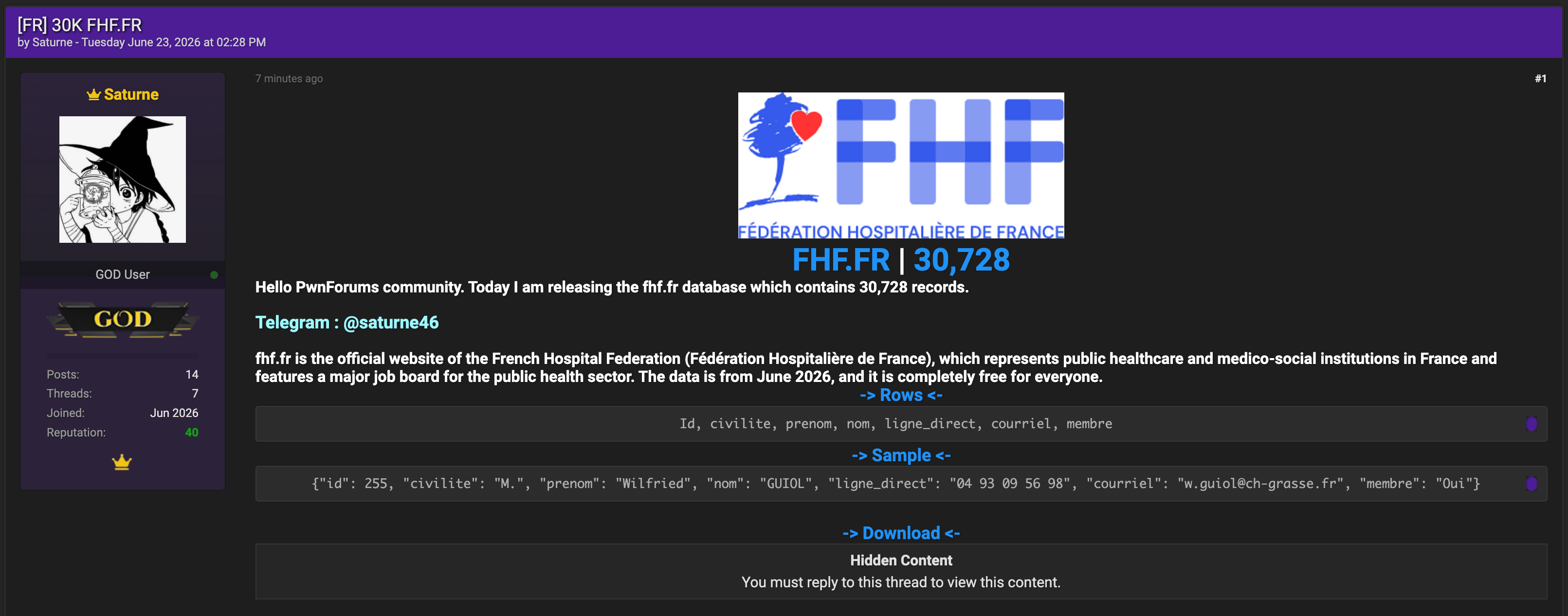
Once initial access is secured or an injection vector is validated, the adversary moves to query the underlying database management system. If using a SQL injection vector, the attacker injects union-based or error-based payloads to query internal database tables such as users, contacts, or membership records. The execution phase involves querying specific tables to compile the target schema: IDs, civility, names, phone lines, emails, and membership status. The retrieved data is then staged locally on the compromised web server in flat files, commonly formatted as CSV, SQL, or JSON, to facilitate rapid, consolidated downloading.
Phase 3: Exfiltration and Publication
To move the compiled data past perimeter defenses, the threat actor exfiltrates the staged files over standard HTTPS connections. By blending the file transfer with normal, legitimate outgoing web traffic, the attacker avoids raising flags in basic network monitoring systems. After successfully completing the transfer, the adversary posts the database on underground marketplaces, such as pwnforums.st, seeking financial gain or reputation within the cybercrime community.