Step 1: Initial Access via Commodity Infostealers
The primary vector driving modern credential exposure is the deployment of commodity infostealer malware, specifically Lumma Stealer, RedLine, and StealC. These payloads are typically delivered via localized email phishing campaigns or malvertising setups that trick enterprise employees into executing unauthorized binaries. Once executed, these lightweight stealers extract cached browser credentials, active session cookies, and VPN configuration profiles from local memory and local database files.
Step 2: Active Directory and SSO Exploitation
Rather than exploiting complex software vulnerabilities, modern threat actors prefer to use valid credentials to log straight into the corporate network. When active web session cookies are stolen, attackers can bypass standard multi-factor authentication (MFA) mechanisms by replicating the authenticated state of the employee browser. In environments where Active Directory Federation Services (ADFS) or single sign-on (SSO) portals are publicly accessible, a single compromised set of corporate credentials can unlock deep administrative directories.
Step 3: Lateral Movement and Data Querying
Once inside the corporate perimeter, attackers conduct internal reconnaissance to locate high value relational databases. In many e-commerce and retail environments, databases containing customer metrics are integrated with web applications such as Magento or enterprise resource planning (ERP) platforms. If endpoints lack active security monitoring, or if internal systems lack network segmentation, the attacker can execute bulk queries to aggregate millions of customer records without triggering alerts.
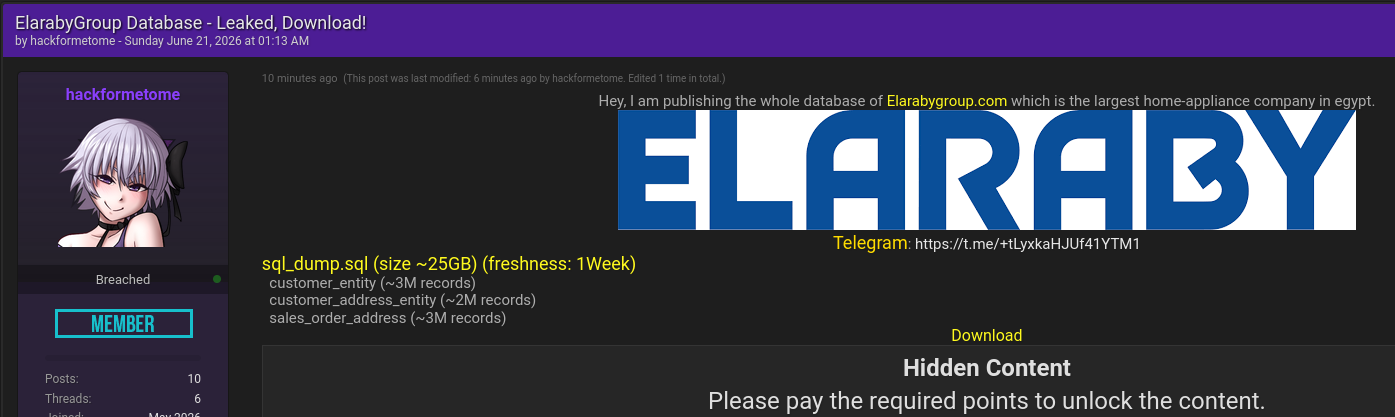
Step 4: Exfiltration of the 25 GB Archive
After aggregating the targeted tables, the threat actor compresses and encrypts the dataset. Exfiltration is usually performed over standard web protocols such as HTTPS or alternative protocols, blending the traffic with normal outgoing corporate network activity. Once successfully exfiltrated, the data is uploaded to illicit underground forums for commercial exploitation or public shaming.
The Enterprise Threat of Downstream Phishing and Social Engineering
A 25 GB dataset consisting of customer addresses and purchase records provides malicious actors with highly contextual, localized data. In the GCC and Egypt, attackers can craft highly convincing social engineering campaigns using specific product purchase details and physical addresses.
Furthermore, corporate credentials leaked alongside consumer data can lead to password stuffing attacks. Because many users reuse passwords across personal and corporate accounts, a breach of customer data can easily escalate into a corporate identity compromise at other enterprises. To counter this risk, proactive Dark Web Monitoring is required to identify compromised credentials before they can be weaponized.