malwarehigh
Collapse HVNC RAT Emergence and Enterprise Risk
The emergence of the Collapse HVNC RAT introduces new risks for remote system control and covert persistence. Learn how to protect your enterprise infrastructure.
The emergence of the Collapse HVNC RAT introduces new risks for remote system control and covert persistence. Learn how to protect your enterprise infrastructure.
Covert access to corporate infrastructure represents one of the most severe risks for modern enterprises, particularly when attackers utilize specialized malware to bypass traditional monitoring. The recent emergence of the Collapse HVNC (Hidden Virtual Network Computing) RAT signifies an evolution in the tools available to malicious actors for maintaining persistent, low-profile control over compromised endpoints. Unlike standard remote access trojans, HVNC-based malware operates within hidden desktop sessions. This allows an adversary to interact with the system, execute applications, and exfiltrate data without disrupting the user's primary desktop activity or triggering obvious indicators of compromise.
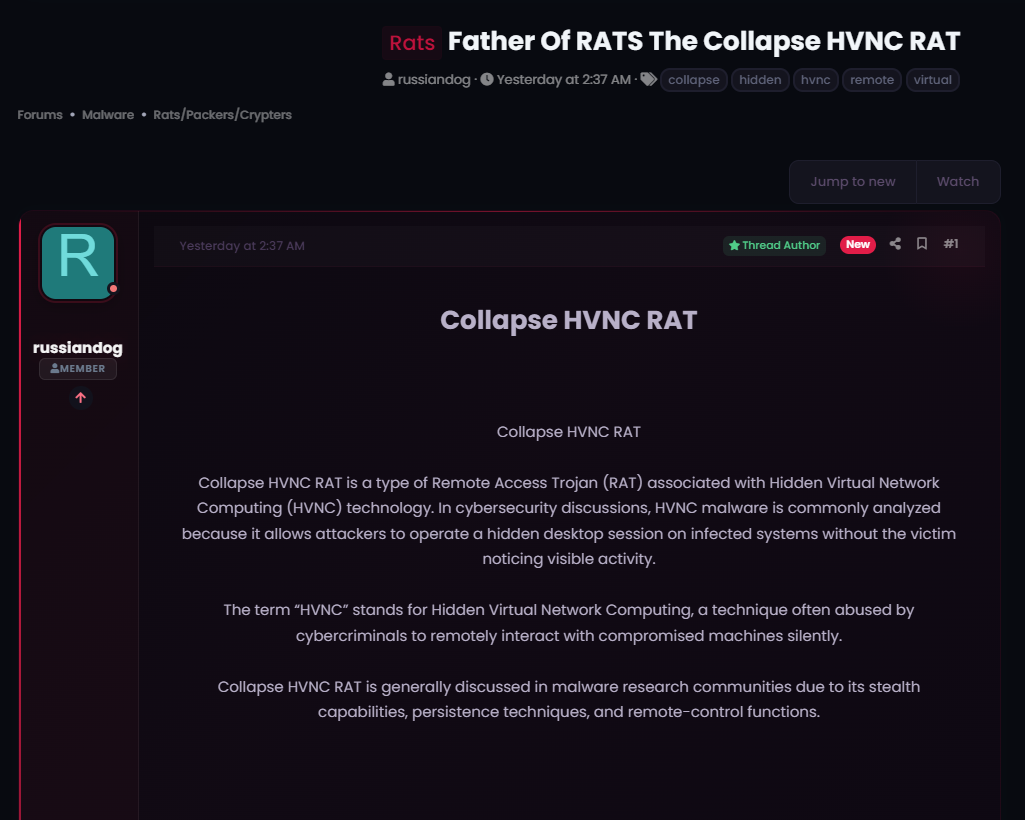
The core danger of Collapse HVNC lies in its ability to facilitate long-term persistence that remains invisible to the standard user. Because the malicious activity occurs in a secondary, hidden environment, an employee might continue using their machine for legitimate business while an attacker operates simultaneously in the background. This capability is frequently leveraged for identity theft, session hijacking, and the deployment of additional malicious payloads. Enterprises that rely on remote workforces or legacy VPN infrastructure are particularly susceptible to the initial access vectors typically used to distribute such RATs. When an endpoint is compromised, the attacker can move laterally throughout the network, potentially escalating privileges and establishing secondary command-and-control channels that are difficult to detect without advanced behavioral analysis.
Defending against advanced threats like Collapse HVNC requires more than static perimeter security. Organizations must adopt an offensive security mindset to validate whether their current controls can withstand a sophisticated, covert intrusion. Engaging in Red Teaming exercises allows security teams to simulate the tactics of an adversary using advanced remote control tools, providing a realistic look at how such an actor would navigate the environment and where their movements might be intercepted. By testing the resilience of your systems, you move from a reactive posture to a proactive defense strategy that prioritizes early detection and rapid containment.
Furthermore, internal applications must be audited to ensure that code-level vulnerabilities do not offer an easy entry point for malware. In scenarios where software supply chain integrity is a concern, a thorough Source Code Review can prevent the inclusion of insecure dependencies that could be exploited to drop RAT-class malware. Security is a continuous process; it is not enough to patch systems once and consider the risk managed. Continuous monitoring of internet-facing assets and the rapid identification of misconfigurations are critical to reducing the overall attack surface.
If the domain already looks exposed, use Dark Web Scanner before requesting a full report. Our diagnostic tool can help you identify if your domain or corporate credentials have already appeared in underground listings, which is a frequent precursor to targeted malware deployment. By monitoring for compromised account indicators and malware log signals, your team can take defensive action before an adversary uses those credentials to establish a footprint on your network.
Free exposure check
Dark Web Scanner
check dark web mentions, compromised account indicators, malware log signals, public breach exposure, and recent underground market activity for your domain.
If your team may be exposed to a similar threat, FemtoSec can help validate blast radius, prioritize remediation, and connect the issue to a practical security program.
June 23, 2026
A technical breakdown of the KNET DDoS malware, an emerging Rust-based tool that abuses public platforms like Pastebin for stealthy C2 communication and features configurable CPU-based attack power. Learn how to detect and contain this threat.
Threat actors are advertising GhostNet, a cross-platform malware targeting Windows, macOS, and Linux with features like HVNC, browser stealing, and reverse proxies. Learn how GhostNet operates, its step-by-step attack chain, and the precise detection and containment strategies needed to secure your enterprise.
July 3, 2026
A threat actor known as the Infrastructure Destruction Squad has commercialized and leaked the source code for TRK25 ADVANCED SCADA, a PyQt5-based tool that targets industrial control systems, remote management ports, and Modbus-enabled machinery.