data breachcritical
Bet365 Breach Assessment: Protecting User Data Integrity
Addressing the reported leak of 120 million records from Bet365 requires immediate assessment. We examine the security implications for users and enterprises.

Addressing the reported leak of 120 million records from Bet365 requires immediate assessment. We examine the security implications for users and enterprises.
Defenders managing high-volume consumer platforms must prioritize the immediate validation of credential integrity and personal data exposure following the reported breach involving 120 million records associated with Bet365. When a breach of this magnitude surfaces, the primary objective is not to speculate on the adversary, but to verify whether internal infrastructure, customer databases, or third-party integrations have served as the vector for such massive data exfiltration. This incident underscores the necessity of maintaining a robust Attack Surface Management posture, as large-scale leaks typically begin with an unmonitored entry point or misconfigured cloud storage that exposes PII and sensitive identifiers.
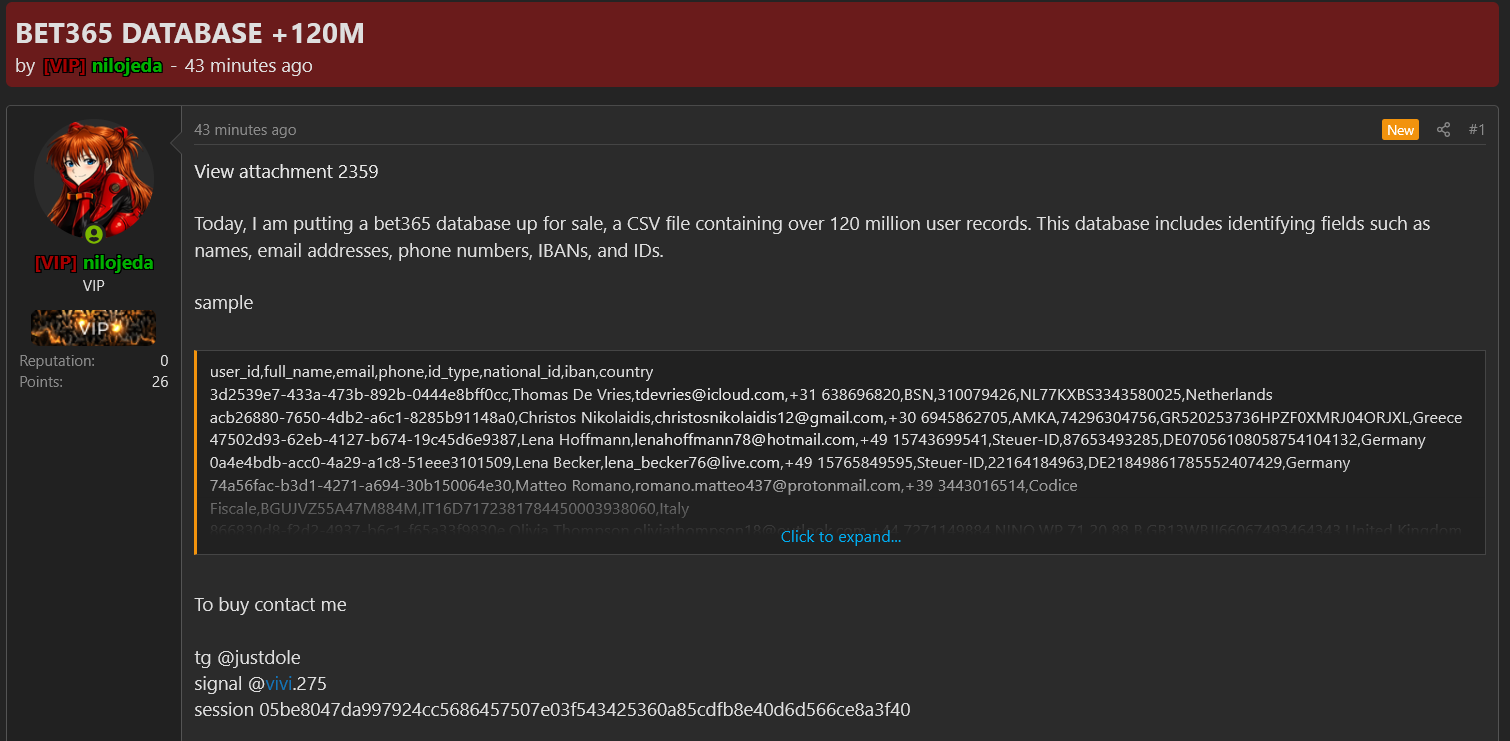
The reported data includes sensitive classes such as names, email addresses, phone numbers, IBANs, and unique IDs. For any organization processing payments or identity-linked data, this represents a severe downstream threat. Adversaries often combine these data points to orchestrate sophisticated social engineering campaigns, account takeover attempts, or secondary financial fraud. Because IBANs and ID numbers are included, the risk extends beyond simple credential stuffing into high-value identity theft and fraudulent transaction monitoring.
Free exposure check
Dark Web Scanner
check dark web mentions, compromised account indicators, malware log signals, public breach exposure, and recent underground market activity for your domain.
The unauthorized acquisition of 120 million records is rarely a localized event. It highlights potential gaps in data lifecycle management. From a security architecture perspective, defenders must evaluate whether their current access controls prevent bulk exfiltration. Implementing granular segmentation and continuous monitoring is the only way to ensure that even if a perimeter is breached, internal databases remain shielded from indiscriminate mass dumping.
Furthermore, organizations must consider how this leaked data interacts with their existing authentication boundaries. Are your internal systems resilient against the automated credential testing that inevitably follows such a release? Regular Penetration Testing is essential to simulate how an adversary would pivot from gaining access to a web application to querying underlying databases or escalating privileges. Proactive security requires assuming that user data is eventually leaked, which necessitates shifting from a perimeter-first mindset to a data-centric security model.
Immediate steps for organizations impacted by large-scale data leaks include:
Identity Validation: Perform an immediate audit of all user accounts associated with the leaked dataset. Force credential rotations if anomalies are detected.
PII Exposure Audit: Evaluate where similar data classes are stored in your environment. Apply encryption-at-rest and strict access controls to ensure these records remain protected.
Log Review: Analyze ingress and egress logs for signs of unusual query volume or data staging activity that could indicate an ongoing extraction process.
Compliance Alignment: Review your alignment with global data protection standards, including PCI-DSS, to ensure that payment-related data like IBANs remains isolated from less sensitive application layers.
Security in the digital age is defined by the speed at which a defender can detect and neutralize an adversary’s advantage. By maintaining strict visibility over all internet-facing assets and periodically validating defensive layers, enterprises can significantly reduce the window of opportunity for attackers to monetize leaked data.
If your team may be exposed to a similar threat, FemtoSec can help validate blast radius, prioritize remediation, and connect the issue to a practical security program.

June 19, 2026
A deep dive into the reported leak of 6 GB of PayXpress business data. Explore the implications for enterprise security and how to safeguard sensitive financial information.

An alleged breach of the Meducar telemedicine platform in Argentina has exposed 3.2 million user records containing sensitive medical, personal, and religious data. Learn how security teams can validate API structures, secure AWS S3 cloud buckets, and implement tactical database containment steps.

An 8 GB SQL database archive has been leaked online, exposing sensitive student records, institutional identifiers, and emails. The incident highlights critical security gaps in public-facing educational platforms and the immediate danger of secondary credential abuse attacks across enterprise environments.