cPanel Authentication Bypass Vulnerability CVE-2026-41940
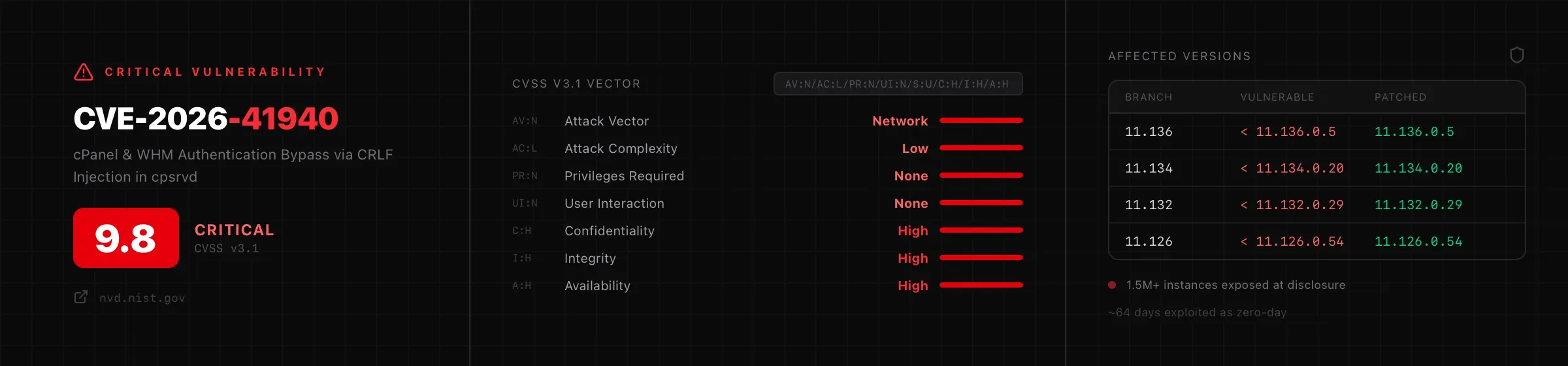
On April 28, 2026, cPanel disclosed one of the most severe vulnerabilities in the history of web hosting infrastructure. Tracked as CVE-2026-41940, this cPanel authentication bypass vulnerability carries a maximum-severity CVSS base score of 9.8 (Critical). It affects all supported installations of cPanel & WHM running versions above 11.40 a range that encompasses virtually every production deployment of the platform worldwide.
The flaw is not theoretical. Rapid7's Emergent Threat Response team, Cloudflare's security operations, and independent threat intelligence feeds have all confirmed active exploitation dating back to at least February 23, 2026 meaning attackers had a roughly two-month head start on defenders. During this window, no patch existed, no CVE had been assigned, and over 1.5 million internet-exposed cPanel instances were silently at risk.
For enterprise organisations operating in the Gulf Cooperation Council (GCC) region including UAE-based financial institutions, government entities, Virtual Asset Service Providers (VASPs) under Dubai's VARA framework, managed service providers (MSPs), and cloud hosting companies this vulnerability is not merely a technical patch item. It is a material cybersecurity risk event that demands an immediate, documented, and auditable response.
9.8
CVSS Base Score (Critical)
1.5M+
Exposed cPanel Instances
~60
Days Exploited as Zero-Day
0
Credentials Required by Attacker
This advisory is written for technical leads, CISOs, compliance officers, and IT administrators who need a comprehensive, actionable breakdown of the cPanel authentication bypass vulnerability along with a clear understanding of what Femto Security's specialized services can do to reduce exposure today and prevent the next incident tomorrow.
Technical Mechanism: How the cPanel Authentication Bypass Works
Understanding the exploit chain of this cPanel authentication bypass vulnerability is essential for evaluating both the severity of your exposure and the completeness of your remediation. The vulnerability is elegant in its exploitation requiring no credentials, no existing account, and no social engineering just a crafted HTTP request.
Root Cause: CRLF Injection in cpsrvd Session Handling
The flaw originates in a Carriage Return Line Feed (CRLF) injection weakness within cpsrvd the core cPanel service daemon responsible for session management and authentication. When a user authenticates to cPanel or WHM, the daemon processes the HTTP Basic Authorization header. Under normal conditions, this header contains a Base64-encoded string representing a username and password pair.
The critical failure: cpsrvd does not sanitize raw \r\n (CRLF) characters from the incoming Authorization header before writing session data to a server-side session file. An attacker can therefore inject arbitrary new lines and arbitrary key-value pairs directly into the session storage on disk.
The Session Promotion Chain
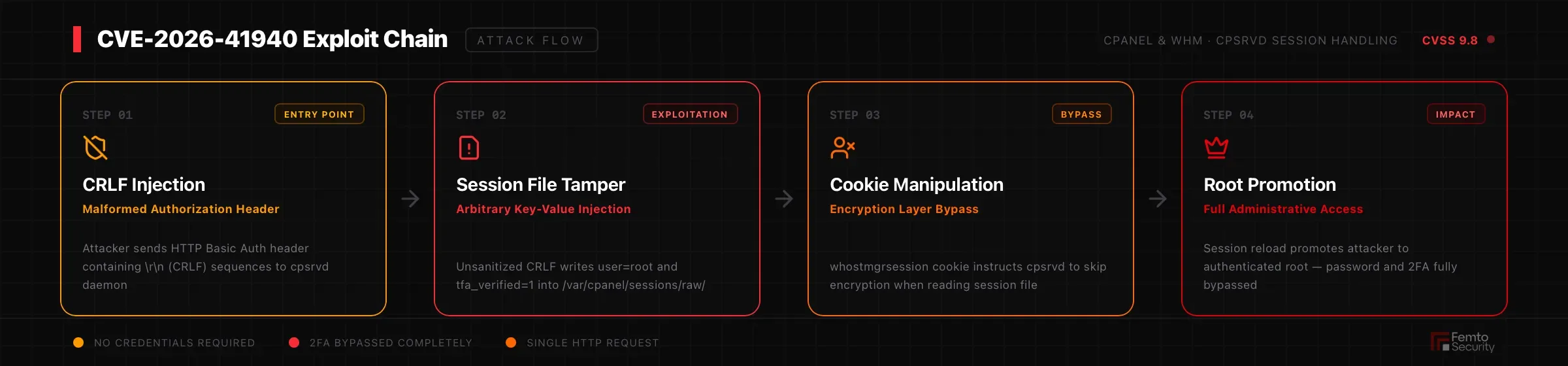
The exploit proceeds in three precise steps:
Step 1 — CRLF Payload Injection. The attacker sends a malformed HTTP Basic Authorization header containing CRLF sequences. Because the daemon writes this unsanitized data directly to the session file at /var/cpanel/sessions/raw/, the attacker can insert arbitrary properties most critically, user=root and tfa_verified=1.
Step 2 — Cookie Manipulation to Skip Encryption. The attacker simultaneously manipulates the whostmgrsession cookie value to instruct cpsrvd to skip its encryption layer when reading the session file. This removes the cryptographic barrier that would otherwise prevent the tampered session data from being parsed.
Step 3 — Session Reload and Privilege Escalation. When the daemon reloads the crafted session file, the injected user=root property "promotes" the unauthenticated attacker's session to a fully authenticated root session. At this point, all credential checks and Two-Factor Authentication (2FA) controls are entirely bypassed.

Why 2FA Does Not Help Here
Many administrators assume that enabling Two-Factor Authentication on WHM provides a backstop against credential-based attacks. CVE-2026-41940 invalidates that assumption entirely. By injecting tfa_verified=1 directly into the session file, the attacker bypasses the 2FA check at the session layer after authentication logic has already run but before the session trust is evaluated. 2FA provides zero protection against this attack vector.
No Credentials. No Account. No Noise
From an attacker's perspective, what makes this cPanel zero-day exploit particularly dangerous is its low operational complexity. The attack requires no valid username, no password, no existing account on the system, and generates minimal log noise compared to brute-force or credential-stuffing attacks. A sophisticated threat actor can execute the full exploit chain with a single specially crafted HTTP request sequence making automated scanning and exploitation at scale entirely feasible across the 1.5 million exposed instances identified at the time of disclosure.
Critical Impact, Exploitation Timeline & Threat Actor Activity
Date | Event | Source |
|---|---|---|
Feb 23, 2026 | Earliest confirmed exploitation in the wild (zero-day phase begins) | Rapid7 ETR |
Late Feb – Apr 2026 | Sustained zero-day exploitation targeting government, military, and MSP infrastructure | Threat Intelligence Feeds |
Apr 28, 2026 | cPanel public disclosure; CVE-2026-41940 assigned; patches released | cPanel / NVD |
Apr 30, 2026 | Cloudflare deploys emergency WAF rules for CVE-2026-41940 signatures | Cloudflare Changelog |
May 2026+ | Opportunistic mass exploitation by secondary threat actors using public PoC | Ongoing |
Who Was Targeted — and Who Is at Risk Now
During the initial zero-day exploitation phase, threat intelligence indicates that sophisticated threat actor groups have shown particular interest in government and military entities in Southeast Asia, as well as managed service providers (MSPs) operating globally. MSPs are a high-value target precisely because compromising a single MSP's cPanel infrastructure can cascade into hundreds or thousands of downstream client environments. This classic supply-chain attack pattern has become a hallmark of state-affiliated and financially motivated advanced persistent threat (APT) groups alike.
Following the April 28 public disclosure, the threat landscape shifted. The release of proof-of-concept (PoC) exploitation code means that lower-sophistication threat actors ransomware affiliates, criminal access brokers, and opportunistic script actors can now weaponize CVE-2026-41940 without any deep technical expertise. This dramatically expands the attacker pool and accelerates the urgency for any unpatched organisation.
GCC Hosting Providers & MSPs: You Are the Priority Target
Organisations providing managed hosting, web infrastructure, or shared cPanel environments across the UAE, Saudi Arabia, Qatar, and wider GCC are uniquely exposed. A single compromised WHM root account can give an attacker control over every hosted domain, every email account, every database, and every client's data on that server. If you have not yet patched, engage Femto Security penetration testing for an emergency compromise assessment.
Affected Versions & Fixed Releases
The cPanel authentication bypass vulnerability affects all supported versions of cPanel & WHM, including versions prior to 11.40. The table below provides a complete reference for both vulnerable and patched release branches. Organisations must ensure they are running a version equal to or greater than the listed fixed releases.
Branch | Vulnerable Versions | Fixed Version | Status |
|---|---|---|---|
cPanel & WHM 11.110 | All builds < 11.110.0.97 | 11.110.0.97 | PATCH AVAILABLE |
cPanel & WHM 11.118 | All builds < 11.118.0.63 | 11.118.0.63 | PATCH AVAILABLE |
cPanel & WHM 11.126 | All builds < 11.126.0.54 | 11.126.0.54 | PATCH AVAILABLE |
cPanel & WHM 11.132 | All builds < 11.132.0.29 | 11.132.0.29 | PATCH AVAILABLE |
cPanel & WHM 11.134 | All builds < 11.134.0.20 | 11.134.0.20 | PATCH AVAILABLE |
cPanel & WHM 11.136 | All builds < 11.136.0.5 | 11.136.0.5 | PATCH AVAILABLE |
WP Squared | All builds < 136.1.7 | 136.1.7 | PATCH AVAILABLE |
cPanel & WHM < 11.40 | All versions | End-of-Life — No Patch | EOL — CRITICAL RISK |
End-of-Life Versions Have No Patch
Organisations running cPanel versions below 11.40 which are already past their end-of-life support date will not receive a patch for CVE-2026-41940. If your infrastructure includes EOL cPanel installations, contact Femto Security's Vulnerability Assessment team to develop an immediate remediation roadmap.
The Ransomware Connection: Sorry, Ransomware & WHM Attacks
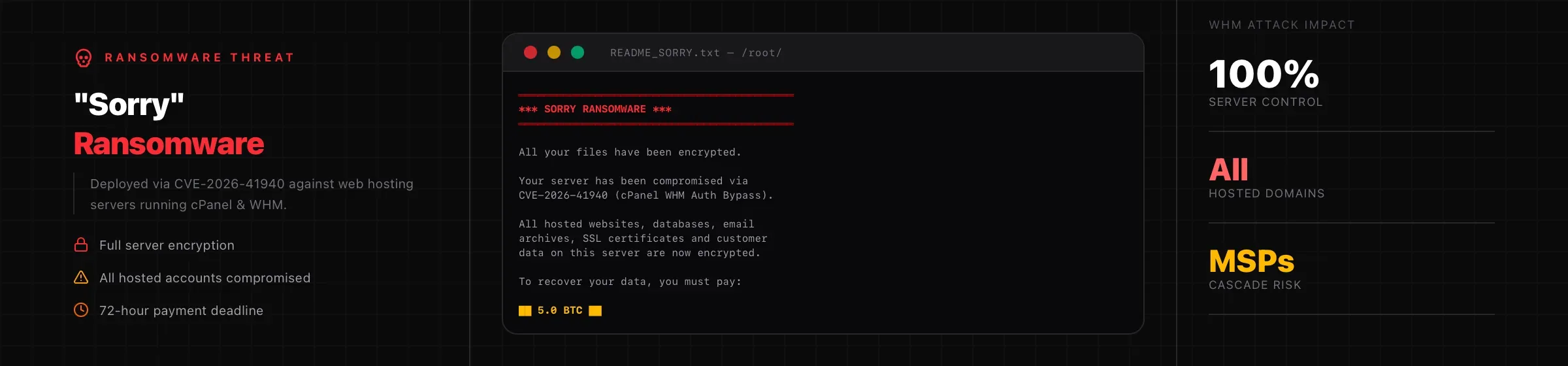
For many organisations, the abstract risk of an authentication bypass crystallises into something far more concrete when they learn about the ransomware deployments observed alongside this exploit chain. Threat actor groups exploiting CVE-2026-41940 have been linked to the deployment of the "Sorry" ransomware family a strain specifically designed for maximum impact on web hosting server environments.
Why Web Hosting Servers Are Ransomware Gold
A WHM ransomware attack on a cPanel root account is categorically more damaging than a standard endpoint ransomware infection. A single compromised WHM root session grants the attacker complete control over the entire server including all reseller accounts, all hosted domains, all associated databases, all email archives, all SSL certificates, and all customer data. The attacker can encrypt everything, exfiltrate credentials for secondary extortion, and use the compromised server as a launchpad for further attacks against the web hosting provider's clients.
The Sorry ransomware family observed in these web hosting server ransomware incidents is notable for its multi-stage approach: initial access via the cPanel zero-day, lateral movement across the server's account tree, data staging and exfiltration to attacker-controlled infrastructure, followed by encryption with a ransom note targeting the hosting company's support channels maximising public pressure and customer-facing damage.
The MSP Cascade Effect
Managed service providers face a compounded risk model. When a WHM ransomware attack succeeds against an MSP's shared hosting infrastructure, the downstream blast radius extends to every client on that server. For MSPs serving enterprises, government contractors, or regulated industries in the GCC, this creates not just operational disruption but also potential regulatory liability including breach notification obligations under UAE data protection law and sectoral frameworks such as those governed by the Central Bank of the UAE or VARA for digital asset businesses.
Femto Security's Dark Web Monitoring service has detected active listings on criminal marketplaces offering cPanel root access to compromised servers indicating that initial access brokers (IABs) are actively monetising this vulnerability even where direct ransomware deployment has not yet occurred. If your organisation's cPanel infrastructure has not been patched, assume access may already have been sold.
Step-by-Step Remediation Guide for the cPanel Security Update
Applying the cPanel security update patch for CVE-2026-41940 is the single most important action your team can take right now. The following guide is structured for server administrators and security teams who need to move quickly and methodically.
Immediate Patch Deployment

If a third-party hosting provider manages your server, escalate immediately to confirm whether the patch has been applied at the infrastructure level. Do not assume automatic updates have run verify explicitly.
Network-Level Access Restriction
While patching proceeds, implement firewall rules to restrict inbound access to cPanel and WHM management ports to known, authorised administrative IP addresses only:
Port | Service | Action |
|---|---|---|
2082 | cPanel (HTTP) | Restrict to admin IPs |
2083 | cPanel (HTTPS) | Restrict to admin IPs |
2086 | WHM (HTTP) | Restrict to admin IPs |
2087 | WHM (HTTPS) | Restrict to admin IPs |
2095 | Webmail (HTTP) | Review & restrict if unused |
2096 | Webmail (HTTPS) | Review & restrict if unused |
Audit Session Files for Indicators of Compromise
Even after patching, you must determine whether your server was compromised during the zero-day window. The primary forensic artefact to examine is the raw session file directory:

Use cPanel's Official Detection Script
cPanel has released an official Indicators of Compromise (IOC) detection script. Run it on every server in your fleet, document the results, and retain logs for compliance and incident response purposes. If you need independent forensic validation, Femto Security Red Teaming can conduct a full compromise assessment.
Log Review & Forensic Preservation
Beyond session files, review the following log sources for anomalous activity correlating with the February–April 2026 exploitation window:
Check WHM access logs at /usr/local/cpanel/logs/access_log for unusual root login events or API calls from unexpected IP addresses. Review /var/log/messages and /var/log/secure for cpsrvd restart events or privilege escalation patterns. Preserve all relevant logs to immutable storage before proceeding with any system changes this is critical for both forensic investigation and regulatory reporting obligations.
Post-Remediation Validation
Remediation is not complete after patching. Engage Femto Security Penetration Testing to conduct a targeted post-patch validation confirming that the specific CVE-2026-41940 attack path is closed, that no persistent backdoors were installed during any potential compromise window, and that your overall WHM security posture meets enterprise hardening standards.
GCC & UAE Enterprise Implications — VARA, Regulated Industries & Compliance Obligations
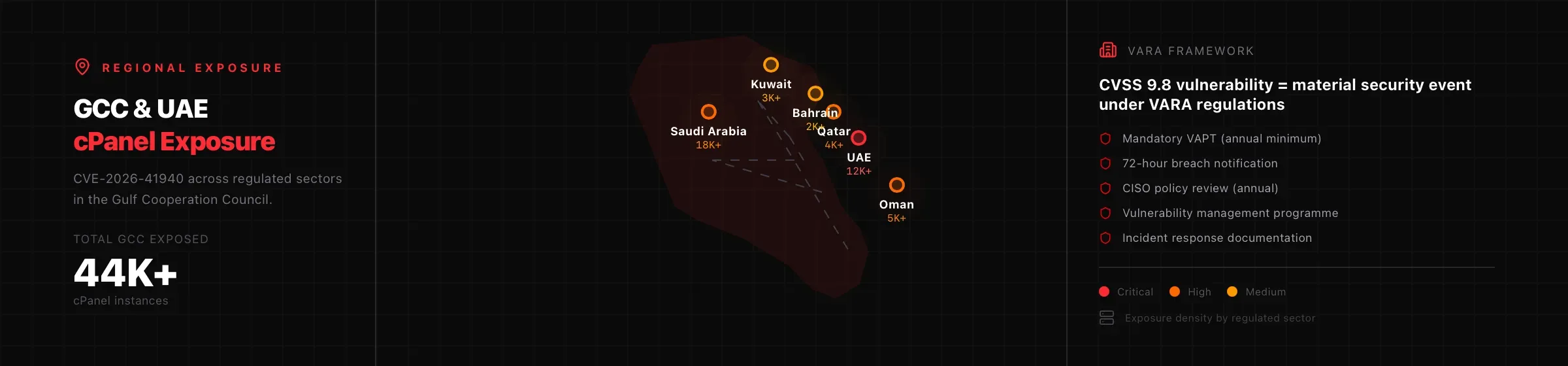
For organisations operating in the United Arab Emirates and the broader GCC region, CVE-2026-41940 carries implications that extend well beyond a standard technical patch cycle. The GCC's increasingly sophisticated regulatory landscape spanning financial services, government, healthcare, and the rapidly maturing Virtual Asset sector creates specific cybersecurity obligations that this vulnerability directly implicates.
VARA Compliance & the CVE-2026-41940 Imperative
Dubai's Virtual Assets Regulatory Authority (VARA) has established one of the world's most detailed cybersecurity frameworks for Virtual Asset Service Providers (VASPs). Under VARA's regulations, licensed entities are required to maintain a robust vulnerability management programme, ensure timely patching of critical vulnerabilities, and report material security incidents within defined timeframes.
A CVSS 9.8 zero-day vulnerability that allows unauthenticated root access to a production web server almost certainly qualifies as a material security event under VARA's framework particularly if that server hosts any component of a licensed VASP's operational infrastructure, customer-facing platform, or transaction processing environment. Failure to patch within a reasonable timeframe and to document that response exposes VASPs to regulatory sanction.
Femto Security's vCISO for VARA Compliance service provides dedicated virtual CISO support to help licensed entities navigate exactly these situations translating a technical security event into a structured, regulatorily defensible response with proper documentation, board-level communication, and evidence of due diligence.
For a deeper understanding of the cybersecurity requirements VARA imposes on digital asset businesses, we recommend reading our detailed guides: VARA Dubai Compliance and VARA Regulatory Compliance Dubai.
ISO 27001 & Information Security Governance
UAE organisations certified under or pursuing ISO 27001 have a specific obligation to respond to critical CVEs within their Information Security Management System (ISMS) frameworks. The patch management and vulnerability response controls in ISO 27001 Annex A directly apply to a scenario such as CVE-2026-41940. Our detailed resource on ISO 27001 in the UAE provides further context on building governance frameworks resilient to exactly these events.
Government & Enterprise: Elevated Risk Profiles
Government entities and large enterprises across the GCC face a uniquely elevated threat profile due to CVE-2026-41940. Threat actors specifically targeted government and military infrastructure during the zero-day exploitation phase indicating that GCC government hosting environments, e-government portals, and public-sector digital infrastructure running cPanel are firmly within the sights of sophisticated adversaries.
Femto Security works directly with government solutions and enterprise organisations across the region to deliver security programmes calibrated to the threat landscape facing public-sector and critical infrastructure operators. Our engagements combine technical depth with an understanding of the regulatory, reputational, and national security dimensions that distinguish these clients from commercial environments.
Why Attack Surface Management Is Non-Negotiable in 2026
CVE-2026-41940 is a textbook illustration of what happens when organisations lack visibility into their external attack surface. Over 1.5 million cPanel instances were internet-exposed, with management ports accessible from the public internet a configuration that, while common, represents a fundamental attack-surface management failure at scale. Many of those 1.5 million server operators had no idea that their WHM interface was reachable from anywhere in the world, let alone that a critical unauthenticated bypass vulnerability existed against it for two months.
Femto Security's Attack Surface Management (ASM) service provides continuous, automated discovery and risk scoring of your externally exposed assets including web hosting management panels, administrative interfaces, legacy systems, shadow IT, and every other internet-facing component that an attacker can discover through passive reconnaissance. When a critical vulnerability like CVE-2026-41940 is published, clients with active ASM programmes receive prioritised alerts identifying exactly which of their assets are affected enabling immediate, targeted response rather than a blind, enterprise-wide search.
In the 2026 threat landscape, the question is no longer whether your organisation will face critical zero-day vulnerabilities. It is whether you will know about them before the attacker exploits them and whether your security programme is structured to respond faster than the adversary can move through your environment.
Passive Reconnaissance: What Attackers Saw Before You Did
Before executing the cPanel authentication bypass, threat actors used passive reconnaissance tools Shodan, Censys, FOFA to enumerate internet-exposed cPanel/WHM management interfaces at scale. They had a complete inventory of vulnerable targets before most defenders even knew the CVE existed. An Attack Surface Management programme gives your security team the same visibility from your side of the perimeter.
How Femto Security Protects Your Infrastructure Against Threats Like CVE-2026-41940
Femto Security is a GCC-focused cybersecurity firm delivering enterprise-grade offensive and defensive security services to organisations across the UAE, Saudi Arabia, and the wider Gulf region. Our service portfolio is purpose-built for the threats that matter most to enterprises, government entities, and regulated industries operating in 2026's threat landscape including exactly the kind of critical infrastructure vulnerability represented by this cPanel authentication bypass vulnerability.
Vulnerability Assessment & Management
Our Vulnerability Assessment service provides comprehensive scanning, prioritisation, and remediation guidance across your entire technology stack including web hosting infrastructure, cloud environments, on-premise servers, and network devices. Every critical CVE is evaluated against your specific asset inventory, giving you actionable prioritisation rather than a generic patch list.
Penetration Testing
Following any critical disclosure, such as CVE-2026-41940, a targeted penetration test is the only way to definitively confirm that your systems were not compromised and that your remediation is complete. Femto Security Penetration Testing conducts automated and manual testing across your production and staging environments, providing documented evidence of your security posture for board reporting, regulatory compliance, and client assurance.
Red Team Operations
For organisations seeking a realistic simulation of how sophisticated threat actors like those who exploited CVE-2026-41940 as a zero-day would move through their environment after initial access, Femto Security Red Team Operations provide full adversary simulation, including lateral movement, privilege escalation, and data exfiltration, calibrated to your actual threat profile.
AI-Agentic Pentesting
Femto Security AI Agentic Pentesting service brings next-generation automation to vulnerability discovery enabling continuous, intelligent security testing that keeps pace with the accelerating cadence of critical disclosures in 2026. Rather than point-in-time assessments, AI-driven pentesting delivers ongoing assurance against emerging attack vectors.
Dark Web Monitoring
Femto Security Dark Web Monitoring service continuously scans criminal marketplaces, ransomware leak sites, and threat actor forums for evidence that your organisation's credentials, data, or infrastructure access has been compromised and listed for sale providing early warning that a CVE-2026-41940 exploitation may have already occurred against your assets.
Security Awareness Training
Even technically robust patch management programmes fail when human factors introduce risk. Femto Security Security Awareness training programme equips your administrative and IT teams to recognise social engineering attempts, respond appropriately to security advisories, and maintain operational hygiene to prevent critical vulnerabilities from becoming breaches. Read our guide on building a Human Firewall for UAE Enterprises in the context of the 2026 threat landscape.
Source Code Review & Smart Contract Auditing
For organisations whose cPanel infrastructure hosts web applications, APIs, or for VARA-licensed entities blockchain-adjacent systems, Femto Security Source Code Review and Smart Contract Auditing services ensure that the application layer above the infrastructure is equally hardened against exploitation.
Is Your cPanel Infrastructure Patched & Secure?
Don't wait for confirmation of a breach. Femto Security's team can conduct an emergency vulnerability assessment and compromise review of your cPanel/WHM environment with results within 24–48 hours for critical-severity engagements.
Key Facts, Statistics & CVE Reference Table
Attribute | Detail |
|---|---|
CVE ID | CVE-2026-41940 |
CVSS Base Score | 9.8 (Critical) — CVSS v3.1 |
Attack Vector | Network (Remote) |
Attack Complexity | Low |
Privileges Required | None |
User Interaction | None |
Scope | Unchanged |
Confidentiality Impact | High |
Integrity Impact | High |
Availability Impact | High |
Vulnerability Type | CRLF Injection / Authentication Bypass |
Affected Component | cpsrvd (cPanel Service Daemon) |
Affected Products | cPanel & WHM (all versions post 11.40), WP Squared |
Disclosure Date | April 28, 2026 |
Zero-Day Window | ~Feb 23 – Apr 28, 2026 (~64 days) |
Publicly Exposed Instances | ~1,500,000+ at time of disclosure |
PoC Available | Yes (post-disclosure) |
Active Exploitation | Confirmed — including APT-level threat actors |
Ransomware Association | Sorry ransomware family (web hosting server attacks) |
Patch Command | /scripts/upcp --force |
Management Ports to Restrict | 2082, 2083, 2086, 2087, 2095, 2096 |
IOC Detection Path | /var/cpanel/sessions/raw/ |
Emergency WAF Protection | Cloudflare WAF (deployed Apr 30, 2026) |

How Severe Is CVSS 9.8?
CVSS Score Range | Severity Rating | Typical Enterprise SLA for Patching |
|---|---|---|
0.1 – 3.9 | Low | 90 days |
4.0 – 6.9 | Medium | 30 days |
7.0 – 8.9 | High | 15 days |
9.0 – 10.0 | CRITICAL | 24–72 hours (emergency) |
A CVSS 9.8 score places CVE-2026-41940 firmly in the top tier of critical severity comparable in score to historic vulnerabilities such as Log4Shell (CVE-2021-44228, CVSS 10.0) and EternalBlue (MS17-010, CVSS 9.8). The combination of zero credentials required, remote exploitability, no user interaction needed, and full root access gained makes this one of the most impactful web infrastructure vulnerabilities disclosed in 2026. Organisations that treat this as a routine patch cycle item do so at extraordinary risk.
Frequently Asked Questions (FAQ)
What exactly is the CVE-2026-41940 cPanel authentication bypass vulnerability?
CVE-2026-41940 is a critical CVSS 9.8 vulnerability in cPanel & WHM caused by a CRLF injection flaw in the cpsrvd session daemon. Unauthenticated remote attackers can inject session file properties including user=root and tfa_verified=1 to gain full administrative root access to the server without any credentials or 2FA codes. All cPanel & WHM versions above 11.40 are affected.
Was CVE-2026-41940 actively exploited before the patch was available?
Yes. Confirmed active exploitation began as early as February 23, 2026 approximately 64 days before the public disclosure and patch release on April 28, 2026. Sophisticated threat actors, including those targeting government and military entities in Southeast Asia and MSPs globally, exploited this as a zero-day for over two months.
Does enabling 2FA on WHM protect against this attack?
No. The exploit specifically bypasses 2FA by injecting the tfa_verified=1 directive directly into the session file. Two-Factor Authentication provides zero protection against CVE-2026-41940. The only remediation is patching to a fixed cPanel & WHM version.
How do I know if my server was compromised during the zero-day window?
Audit the raw session file directory at /var/cpanel/sessions/raw/ for session files containing user=root or hasroot=1 that do not correspond to legitimate administrative logins. Run cPanel's official detection script: /usr/local/cpanel/scripts/detect_cve_2026_41940. For independent forensic validation, contact Femto Security Penetration Testing.
What is the connection between Sorry ransomware and cPanel attacks?
Threat actors exploiting CVE-2026-41940 have been observed deploying the "Sorry" ransomware family against compromised web hosting servers. Because WHM root access grants control over an entire server including all hosted accounts, databases, and files these ransomware attacks can be catastrophic in scale, particularly for MSPs and hosting providers serving multiple clients.
Are UAE and GCC organisations specifically at risk?
Yes. GCC hosting providers, MSPs, government entities, and VARA-licensed Virtual Asset Service Providers all operate cPanel-based infrastructure and face both technical risks of exploitation and regulatory risks of compliance failure if they do not respond promptly to a CVSS 9.8 zero-day. Femto Security vCISO for VARA Compliance service supports regulated entities in documenting and demonstrating their response.
How can Femto Security help my organisation respond to CVE-2026-41940?
Femto Security offers emergency vulnerability assessments, compromise investigations, post-patch penetration testing for validation, continuous attack surface management, and dark web monitoring to detect whether your infrastructure access has already been listed for sale. Contact our team for a prioritised response plan tailored to your environment and regulatory context.
Continue Reading
What is zero Trust security removes implicit trust from users and devices. Learn how it works, why UAE enterprises need it, and how to implement it.
Discover what security awareness training is, the topics every program must cover, and how UAE and GCC organizations meet VARA and ISO 27001 requirements.

Complete UAE cybersecurity regulations guide for banks, fintech, govt, crypto: CBUAE, VARA, DESC ISR and ADHICS frameworks explained clearly.