
critical
June 12, 2026
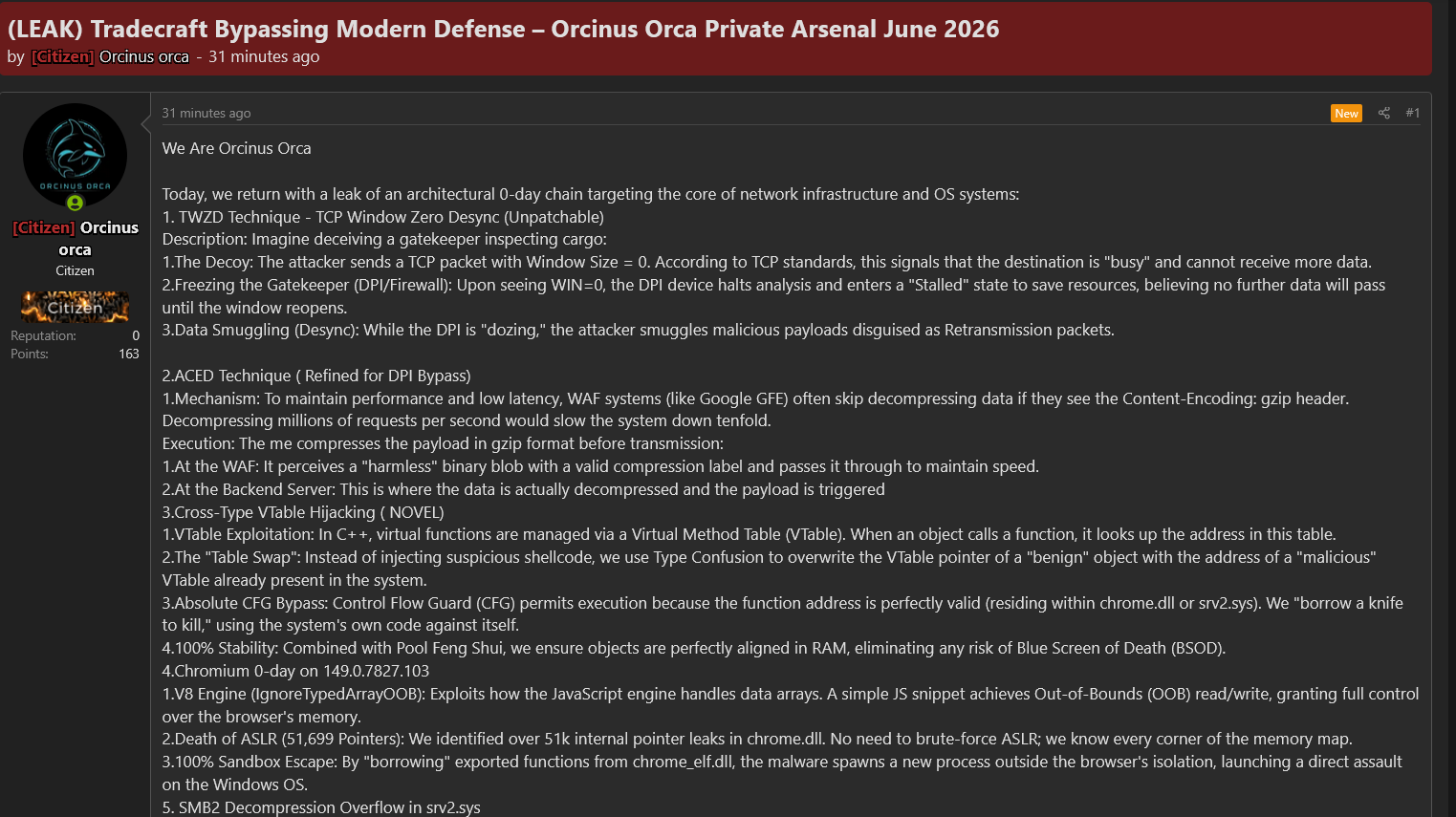
A threat actor claims to possess advanced zero-day exploits and attack techniques targeting network infrastructure and browsers. We analyze the implications for enterprises.
If your team may be exposed to a similar threat, FemtoSec can help validate blast radius, prioritize remediation, and connect the issue to a practical security program.
Emerging threats involving hVNC and hRDP zero-day exploits are circulating in underground forums. Organizations must assess their exposure and strengthen remote access security.

An alleged sale of unpatched critical zero-day exploits targeting Floci, Gitea, libssh, and c-ares highlights a growing threat. While the zero-day claims on dark web forums are likely fraudulent, the weaponization of legitimate public research repositories poses an immediate risk to enterprise networks.
June 21, 2026
A threat actor is reportedly offering a malware framework exploiting vulnerabilities in libsodium and NaCl. We analyze the risks to enterprise cryptographic integrity and provide mitigation steps.
In the evolving landscape of digital threats, the report of a new zero-day exploitation arsenal represents a significant escalation in how adversaries approach network compromise. Recent intelligence indicates a threat actor claims to hold a collection of sophisticated exploits targeting a wide array of systems, including network infrastructure, web security controls, and Chromium-based browsers. While such claims frequently surface in underground forums, the assertion of capability regarding kernel-level privilege escalation, sandbox escapes, and DPI/WAF bypass techniques demands a rigorous, proactive security response from enterprise leadership.
The reported arsenal allegedly targets critical components of the modern IT stack, such as SMB services and Windows environments. By focusing on fundamental elements like browser security and WAF bypass, the adversary aims to strip away layers of defense that organizations typically rely upon. For businesses operating within the GCC region, these claims are a reminder that traditional perimeter defenses are often insufficient against advanced, multi-stage attack chains.
Organizations must shift from passive observation to active validation. Relying on vendor-supplied patches is necessary but rarely sufficient when unknown vulnerabilities are in play. A robust Vulnerability Assessments strategy is the first step in identifying weak points that these tools might leverage. By continuously auditing your environment, you move from reactive patching to a stance where you understand your actual exposure before an attacker can exercise a zero-day exploit.
Furthermore, because these techniques claim to bypass web security controls, you must ensure that your external-facing footprint is minimized. Our Attack Surface Management services provide the visibility required to eliminate ghost assets and misconfigured endpoints that provide the initial foothold for such advanced campaigns.
Free exposure check
Dark Web Scanner
check dark web mentions, compromised account indicators, malware log signals, public breach exposure, and recent underground market activity for your domain.
True resilience is born from the ability to withstand an assault even when specific CVEs are not yet known. This is where Red Teaming becomes critical. By simulating these advanced adversary techniques in a controlled environment, we can help your security teams develop the detection logic required to flag anomalous behaviors, such as unexpected kernel calls or suspicious browser interactions, that are indicative of an attempt to use such toolkits.
While the claims in the source news lack independent technical verification, the theoretical capability they suggest poses a risk to critical infrastructure and enterprise stability. We recommend a focus on layered defense, prioritizing the restriction of outbound traffic from sensitive network segments and the hardening of browser-based environments where end-users interact with internet-facing resources.