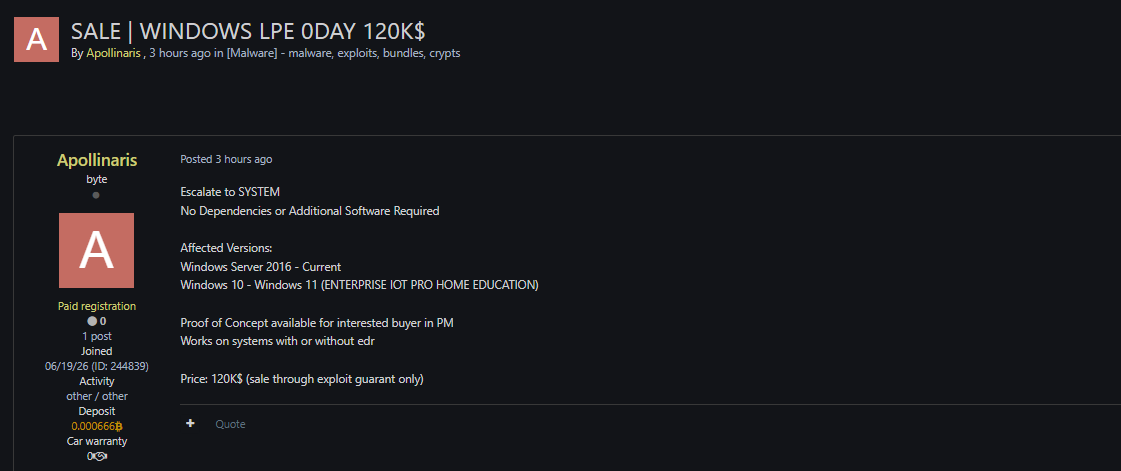
For enterprise leadership in the GCC, the primary risk is not just the vulnerability itself, but the speed at which such exploits can be weaponized in the wild. When a threat actor claims to have a functional LPE exploit, the technical barrier for attackers to move from an initial point of entry to a full domain compromise is significantly reduced. This shift demands a change in how we evaluate our internal security resilience and incident response readiness.
Technical Implications for System Integrity
Local Privilege Escalation exploits function by targeting systemic flaws in the operating system kernel or privileged system services. Once executed, the malicious payload can gain full control over the machine. In an enterprise environment, this means that a single compromised endpoint from a phishing attack or a minor web vulnerability can quickly evolve into an infrastructure-wide security event if the LPE chain is successfully triggered. Organizations must move beyond static perimeter defense and focus on granular, identity-centric security policies.
Effective mitigation requires a proactive approach to Vulnerability Assessments, which help identify whether the underlying components that could be susceptible to such exploits are adequately hardened. Understanding your attack surface is critical, especially when new zero-day threats are identified in the wild. Our team specializes in simulating these attack paths to ensure your defenses are not just theoretical, but functionally robust against advanced adversaries.
Strengthening Your Defense Posture
While specific patches for undisclosed zero-days may not yet exist, enterprise security teams can implement compensating controls to minimize the blast radius of a successful compromise. These include:
Least Privilege Enforcement: Strictly limiting the use of local administrator accounts on end-user workstations.
Continuous Asset Monitoring: Utilizing Attack Surface Management to maintain visibility over exposed assets and potential entry vectors.
Kernel and Service Hardening: Implementing strict endpoint detection and response configurations that monitor for unusual privilege escalation attempts.
Behavioral Analytics: Monitoring for atypical process behavior that deviates from standard administrative workflows.
Without immediate visibility into where your assets are most vulnerable, reactive patching becomes a guessing game. FemtoSec offers a compliance-first, proactive operating model that ensures your security posture is hardened against these types of zero-day risks within 10-14 days. Whether it is refining your Penetration Testing strategy or ensuring that your Compliance Services are aligned with current threat intelligence, we provide the enterprise-grade expertise needed to navigate these technical threats.