New Payment Phishing Kits Target Stripe and 3DS Systems
Threat actors are distributing advanced phishing and credit card harvesting toolkits designed to exploit payment gateways. Learn how these threats impact your enterprise and how to defend your infrastructure.
Key Takeaways
- Advanced toolkits now automate phishing for Stripe and 3DS systems.
- The kits include anti-CIS filtering to bypass regional security filters.
- Attackers can easily embed malicious components into legitimate websites.
- Automated payment fraud kits are becoming more accessible to low-skilled threat actors.
Emerging Threats to Payment Infrastructures
The recent emergence of a sophisticated credit card mining toolkit targeting Stripe and 3DS-enabled payment systems signals a troubling evolution in cybercriminal tactics. As enterprises increasingly rely on digital payment gateways, these specialized toolkits simplify the execution of high-scale fraud by providing attackers with automated phishing infrastructure, NFC-related card abuse capabilities, and anti-CIS filtering techniques.
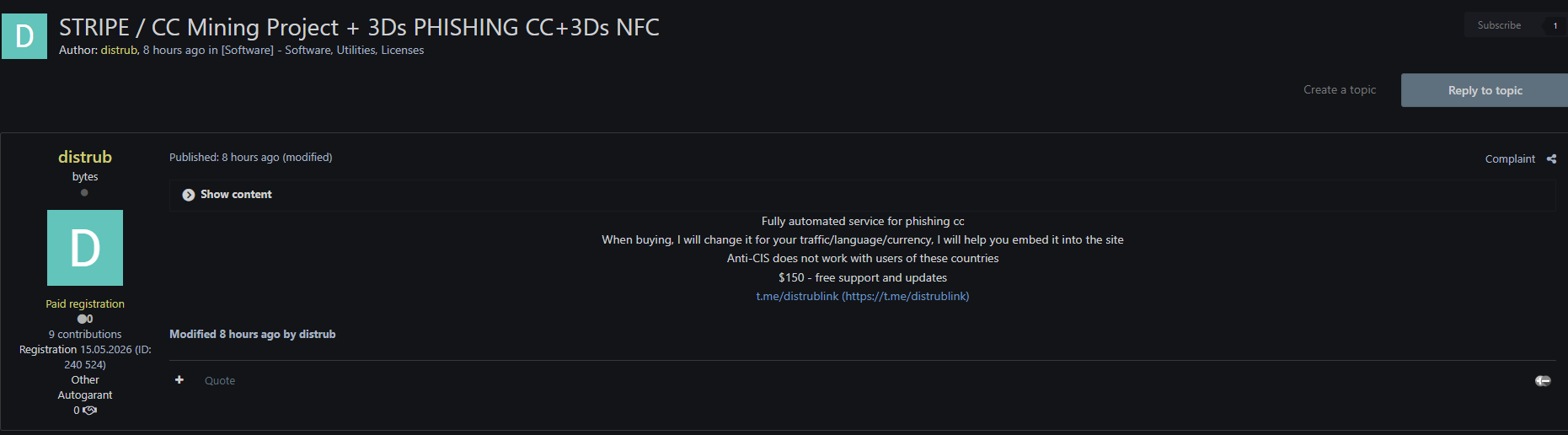
This development underscores the necessity for a proactive defense strategy. When threat actors gain access to tools that automate the bypass of common security measures like 3DS authentication, the risk to sensitive financial data increases exponentially. It is not enough to rely on standard perimeter security; organizations must validate the integrity of their web applications and payment workflows continuously.
The Anatomy of Modern Payment Fraud
The reported toolkit is designed to be highly modular, offering customizable language and currency support that allows attackers to launch targeted campaigns against specific regional demographics. Furthermore, the inclusion of assistance for embedding phishing components directly into existing, legitimate websites makes these attacks particularly difficult for end-users to detect. Our Penetration Testing services help identify how such phishing components could be integrated into your platforms and assess your resilience against these sophisticated vectors.
For enterprise security teams, the threat is multifaceted. Beyond the direct theft of payment information, these attacks can damage brand reputation and result in significant compliance failures. Maintaining a secure environment requires a deep understanding of your Attack Surface Management to ensure that no unauthorized components or misconfigurations remain accessible to potential intruders.
Building Enterprise Resilience
To defend against these types of automated toolkits, organizations should adopt a compliance-first, proactive operating model. FemtoSec helps enterprises within the GCC region strengthen their security posture by simulating real-world threats and testing defensive layers. By integrating threat intelligence into your daily operations, you can identify and mitigate the risks posed by such tools before they impact your customer base or financial operations.
The integration of advanced phishing techniques into readily available toolkits means that the barrier to entry for cybercriminals continues to lower. We recommend a comprehensive review of all public-facing assets to ensure that your payment flows are hardened against automated interception and injection attempts. A proactive assessment today can prevent a costly data breach tomorrow.
How to Defend Against Similar Threats
- Conduct regular penetration testing on all payment gateway integrations.
- Implement continuous monitoring of web applications for unauthorized code changes.
- Strengthen end-user authentication protocols beyond standard 3DS requirements.
- Audit your external attack surface to remove unnecessary exposure points.
Threat Intel FAQ
How can my organization detect if our payment pages are being targeted by these kits?
Does 3DS provide enough protection against these new toolkits?
Could a similar threat affect your organization?
If your team may be exposed to a similar threat, FemtoSec can help validate blast radius, prioritize remediation, and connect the issue to a practical security program.
Related Threats

A recently identified phishing toolkit targeting Gmail users is making rounds on underground forums. This tool facilitates automated credential harvesting and proxy-based obfuscation, posing a significant risk to organizational security.
June 3, 2026
HeartSender V6 Leaked: Risks to Email Security
The emergence of the HeartSender V6 platform leak highlights the ongoing risks of mass-email delivery tools in the wild. We analyze the implications and provide defensive strategies.
June 30, 2026
Bluekit PhaaS Targets E-Commerce with AiTM Attacks
A deep dive into the Bluekit and SnagX Phishing-as-a-Service platforms, analyzing how threat actors utilize Adversary-in-the-Middle reverse proxies to bypass multi-factor authentication and execute automated account takeovers targeting e-commerce credentials.