Rwanda Health Ministry 5.7 GB Data Breach Analysis
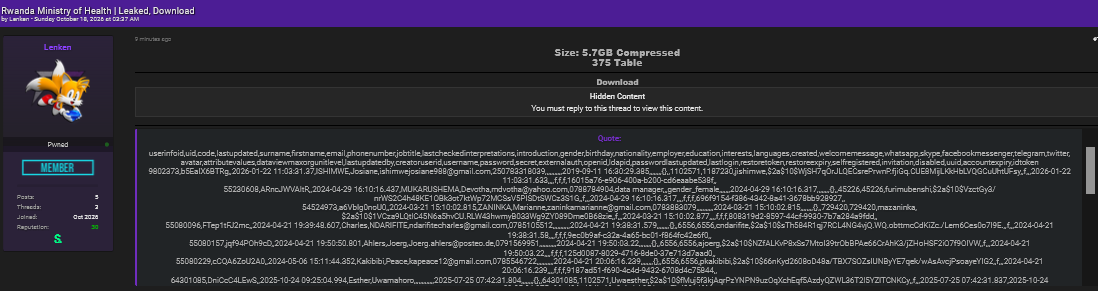
An illicit forum listing claims the exfiltration and sale of 5.7 GB of citizen and staff records from the Rwanda Ministry of Health, exposing personal identifiers and highlighting the threat of upstream infostealer compromises.

Key Takeaways
- A threat actor advertised an alleged 5.7 GB database containing personal identifiers from the Rwanda Ministry of Health.
- Exfiltrated records reportedly include citizen and staff national IDs, full names, email addresses, and phone numbers.
- Compromises of this nature typically originate from upstream infostealer credential theft or exposed web application interfaces.
- Mitigation requires immediate administrative session revocation, mandatory multi-factor authentication, and strict query rate limiting.
A threat actor operating on cybercrime forums has announced the unauthorized sale of an alleged 5.7 GB database exfiltrated from the Rwanda Ministry of Health (moh.gov.rw). The illicit listing states that the compromised records contain citizen and healthcare personnel personally identifiable information, specifically national identification numbers, first names, registered email addresses, and contact phone numbers. While independent forensic verification by national computer emergency response teams remains ongoing, the incident highlights persistent adversary campaigns targeting public sector healthcare management infrastructure across developing digital ecosystems.
Public health institutions manage sprawling digital attack surfaces spanning patient registries, electronic health records, supply chain distribution databases, and workforce management portals. In many administrative environments, external-facing web applications interface directly with backend relational databases without sufficient network segmentation or query rate limiting. When threat actors acquire administrative credentials through upstream infostealer infections or locate exposed database management interfaces, they can stage bulk table extractions that undermine citizen privacy and create long-tail spear-phishing exposure.
Free exposure check
Dark Web Scanner
check dark web mentions, compromised account indicators, malware log signals, public breach exposure, and recent underground market activity for your domain.
Incident Scope Metrics
Capabilities and Behavior
The malicious behavior associated with large-scale database compromises targeting public sector registries combines automated reconnaissance, credential replaying, and bulk structured data scraping. Threat actors monitor underground cybercrime repositories for administrative credentials harvested by widespread information stealers. Once valid session cookies or administrative credentials for web-facing healthcare subdomains are acquired, the adversary bypasses perimeter defenses without generating standard signature-based intrusion alerts.
The primary capability demonstrated in database extractions of this profile involves authenticated or semi-authenticated structured query execution. Adversaries utilize standard database utility queries or script automated data enumeration tools that systematically page through user tables. Key behaviors observed during health record database incidents include:
Mass Row Extraction: Executing queries with unbounded
SELECTstatements across identity tables, targeting columns namedid,first_name,email, andphone_number.Automated Schema Enumeration: Interrogating information schema tables to map foreign key relationships and identify high-value personnel directories.
Archive Compression: Staging exfiltrated data locally using system compression utilities such as
tar,gzip, orzipto consolidate raw text dumps into transportable archives.Secondary Extortion and Monitization: Packaging the data into multi-gigabyte flat files and advertising them on underground marketplaces to broker illicit sales.
The resulting 5.7 GB dataset presents severe identity theft and fraud hazards. Threat actors can correlate phone numbers and national identification codes with corporate and financial registries to conduct targeted SIM swapping, credential stuffing, and highly convincing social engineering campaigns against public sector personnel.
Compromised Data Exposure
- National Identification Numbershigh
- First Nameshigh
- Registered Email Addressesmedium
- Contact Phone Numbershigh
Infection Chain and Persistence
The infection chain leading to public health database compromises generally follows one of two distinct trajectories: an infostealer-mediated credential takeover or direct exploitation of web-facing portal vulnerabilities. Continuous attack surface management is essential to discover exposed administrative interfaces before adversaries do.
Phase 1: Initial Compromise and Access Brokerage
Commodity malware families such as Rhadamanthys, Vidar, and RedLine frequently infect administrative endpoints through malicious search engine advertisements, cracked software packages, or targeted phishing attachments. Once resident on a workstation, the malware harvests stored browser passwords, session tokens, and local database credentials stored in SQLite application profiles. Threat actors subsequently filter these stealer logs for government domain extensions, identifying valid logins for systems such as the Health Management Information System (HMIS) or staff webmail.
Alternatively, adversaries scan perimeter IP ranges for unpatched content management systems, outdated open-source health platforms, or exposed database administration tooling such as phpMyAdmin or Adminer. Vulnerabilities involving SQL injection (SQLi) or broken object-level authorization (BOLA) allow unauthenticated external actors to interact directly with internal database engines.
Phase 2: Execution and Data Staging
Upon acquiring access, the adversary establishes an interactive session via an administrative portal or direct database port. They execute queries to determine system privileges and check if elevated access permits filesystem read/write operations. In environments lacking strict data loss prevention controls, actors write query outputs directly to web-accessible directories or export dump files to temporary directories such as /tmp or C:\Windows\Temp.
Phase 3: Persistence and Defense Evasion
To maintain access across defensive sweeps, threat actors frequently deploy secondary webshells disguised within legitimate application directories or create rogue administrative accounts within the application database. If access was facilitated by stolen session tokens, persistence remains active until session revocation occurs or authentication keys are invalidated across the identity provider.
Observed Compromise Sequence
- 1Initial Access
Infostealer credentials (Rhadamanthys/Vidar) or web app exploit
- 2Query Execution
Automated schema enumeration and mass SELECT statements
- 3Local Staging
Archive compression (tar/gzip/zip) in temporary directories
- 4Persistence
Rogue admin accounts and web shell deployment
Command and Control
Because database compromise campaigns frequently decouple initial intrusion malware from subsequent manual data exfiltration, command and control architectures operate on multiple tiers. In the preliminary infostealer stage, malware payloads communicate with dynamic command and control servers over encrypted HTTP/HTTPS protocols, delivering encrypted zip bundles of harvested browser credentials to adversary-controlled endpoints.
During the database extraction and staging stage, the threat actor operates either through commercial virtual private networks, Tor exit nodes, or compromised residential proxy networks to mask their true origin IP address. Data exfiltration does not typically rely on traditional persistent remote access trojan C2 channels; instead, adversaries transfer bulk archives out-of-band via encrypted web traffic, secure file transfer protocol (SFTP), or direct uploads to ephemeral cloud storage hosting providers. Monitoring egress bandwidth thresholds across database demilitarized zones remains the most reliable method for disrupting unauthorized transfers.
Adversary TTP Mapping
Detection Logic and Indicators
Detecting database intrusions requires proactive correlation across web server access logs, database query audit trails, and endpoint telemetry. Organizations must implement targeted detection logic capable of identifying bulk data querying and anomalous administrative logins.
Database Audit Log Analysis
Security operations centers should monitor database audit logs for anomalous query volume and off-hours table scraping. The following SQL query helps database administrators detect suspicious bulk record extractions across audit tables:
SELECT client_ip, user_name, COUNT(*) AS query_count, SUM(rows_sent) AS total_rows_exportedFROM db_audit_logsWHERE query_text ILIKE ANY ('%SELECT%id%email%phone%', '%SELECT * FROM users%', '%SELECT * FROM staff%') AND event_timestamp >= NOW() - INTERVAL '14 days'GROUP BY client_ip, user_nameHAVING SUM(rows_sent) > 25000;Network Egress Detection Rule
Defenders can deploy network detection rules to spot abnormal outbound data transfers originating from internal database clusters or application web servers hosting public health services:
title: High-Volume Outbound Data Transfer from Database Subnetstatus: productiondescription: Detects outbound network connections exceeding 500 MB originating from database network segments.logsource: category: network_trafficdetection: selection: src_ip: - '10.10.40.0/24' - '172.16.50.0/24' bytes_out: '> 524288000' filter: dst_ip: - 'Authorized_Cloud_Backup_Endpoints' condition: selection and not filterlevel: highIndicators of Compromise
While specific network infrastructure indicators for this forum listing remain restricted to dark web brokerage channels, defenders should inspect telemetry for known operational indicators:
Targeted Domains:
moh.gov.rw,hmis.moh.gov.rwFile Artifacts: Unscheduled database archives bearing names such as
moh_dump.sql,users_backup.tar.gz, or randomly named zip archives in web directories.Process Execution: Non-browser administrative binaries accessing browser data paths like
AppData\Local\Google\Chrome\User Data\Default\Login Data.
Removal and Recovery
Responding to an alleged ministerial database breach requires containment procedures that neutralize existing access vectors and prevent subsequent identity exploitation across the public sector ecosystem.
1. Enterprise Credential Revocation
Execute an immediate, mandatory credential reset for all administrative, developer, and general personnel accounts associated with the affected systems. Invalidate all active session tokens, OAuth bearer grants, and API keys across both on-premises portals and connected cloud services. Enforce phishing-resistant multi-factor authentication across all external access portals.
2. Perimeter Isolation and Vulnerability Remediation
Conduct comprehensive penetration testing across public-facing health subdomains to discover and patch injection vulnerabilities, misconfigured administrative interfaces, and broken access controls. Restrict direct access to database ports and administrative management consoles to dedicated internal management bastions protected by virtual private networks.
3. Data Loss Prevention and Application Hardening
Implement strict database rate limiting and pagination constraints at the application layer to prevent single-query bulk dumps. Configure web application firewalls to block SQL injection patterns and automated scraping bots attempting to traverse citizen registries.
4. Regulatory Alignment and Identity Support
Engage regulatory authorities, including national data protection offices, to initiate forensic evaluations under relevant privacy laws. Provide actionable alerts to affected individuals whose emails and phone numbers have circulated on underground forums, instructing them to remain alert against targeted phishing and identity spoofing attempts. If your organization requires assistance assessing perimeter exposure and validating controls, you can schedule a technical consultation with our offensive security team.
How to Defend Against Similar Threats
- Invalidate all active session tokens and enforce global password resets across public health administrative portals.
- Implement multi-factor authentication backed by hardware keys or authenticator apps to mitigate stolen credential reuse.
- Deploy database query volume monitoring to alert on full-table SELECT dumps and anomalous row extractions.
- Conduct thorough penetration testing and attack surface discovery across all public-facing healthcare subdomains.
Threat Intel FAQ
What information was allegedly compromised in the Rwanda Ministry of Health leak?
How do adversaries typically obtain bulk database exports from government health portals?
What immediate steps should organizations take when citizen PII is exposed on cybercrime forums?
Could a similar threat affect your organization?
If your team may be exposed to a similar threat, FemtoSec can help validate blast radius, prioritize remediation, and connect the issue to a practical security program.
Related Threats
October 1, 2026
FATETRAFFIC Threat Actor Sells Stealer Logs
A threat actor has advertised a batch of 3,100 FATETRAFFIC stealer logs on underground cybercrime forums. The archive contains harvested browser credentials, active session tokens, and endpoint metadata collected through widespread information-stealer malware operations.

September 18, 2026
Hermes Stealer Emerges with HVNC and Token Theft
A new malware-as-a-service offering named Hermes has surfaced on underground forums, bundling hidden virtual desktop control, browser credential harvesting, crypto wallet theft, and remote command execution.
September 13, 2026
RedLine VIP Infostealer Log Sale Exposes 295k Records
Underground threat actors are actively marketing a massive 543 GB archive of RedLine VIP infostealer logs containing 295,631 harvested victim records. The exfiltrated data encompasses plaintext credentials, active browser session tokens, cryptocurrency wallet keys, and sensitive enterprise system metadata.