Vulnerability Assessment vs Penetration Testing: What Every UAE Business Needs to Know in 2026
When it comes to protecting your organisation from cyber threats, two terms come up more than almost any others: vulnerability assessment and penetration testing. They are often used interchangeably and that is a costly mistake. Understanding the difference between vulnerability assessment and penetration testing is not just a technical exercise; it is a business-critical decision that shapes your entire security posture.
Whether you run a fintech startup seeking VARA compliance in Dubai, a government entity, or a multinational enterprise, knowing which security method to deploy and when can be the difference between a minor incident and a catastrophic breach. This guide breaks it all down clearly, so you can make confident, informed decisions about your cybersecurity investment.
What Is a Vulnerability Assessment?
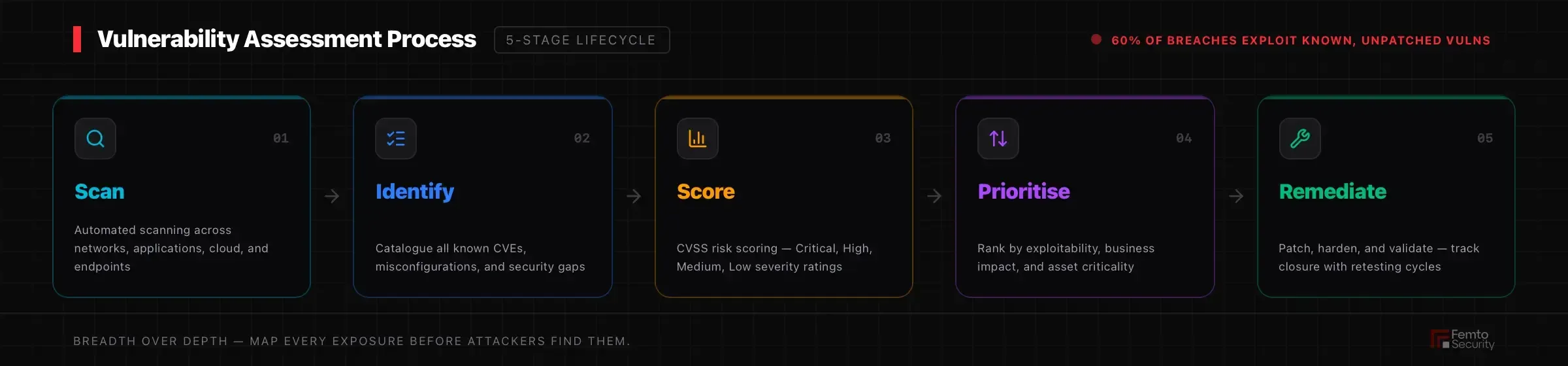
A vulnerability assessment (VA) is a systematic process of identifying, quantifying, and prioritising known security weaknesses across your IT environment. Think of it as a comprehensive health check for your digital infrastructure. Using automated scanning tools and predefined vulnerability databases, a VA scans your systems networks, servers, applications, and cloud environments and generates a prioritised list of weaknesses that need attention.
The goal is breadth, not depth. A vulnerability assessment does not attempt to exploit the weaknesses it finds. Instead, it catalogues them and assigns risk scores, typically using frameworks like CVSS (Common Vulnerability Scoring System), so your security team or managed service provider knows where to focus patching efforts first.
At Femto Security, our vulnerability assessment services are designed to give organisations in the UAE especially those operating in regulated sectors a real-time, accurate picture of their security gaps before attackers find them.
What Is Penetration Testing?
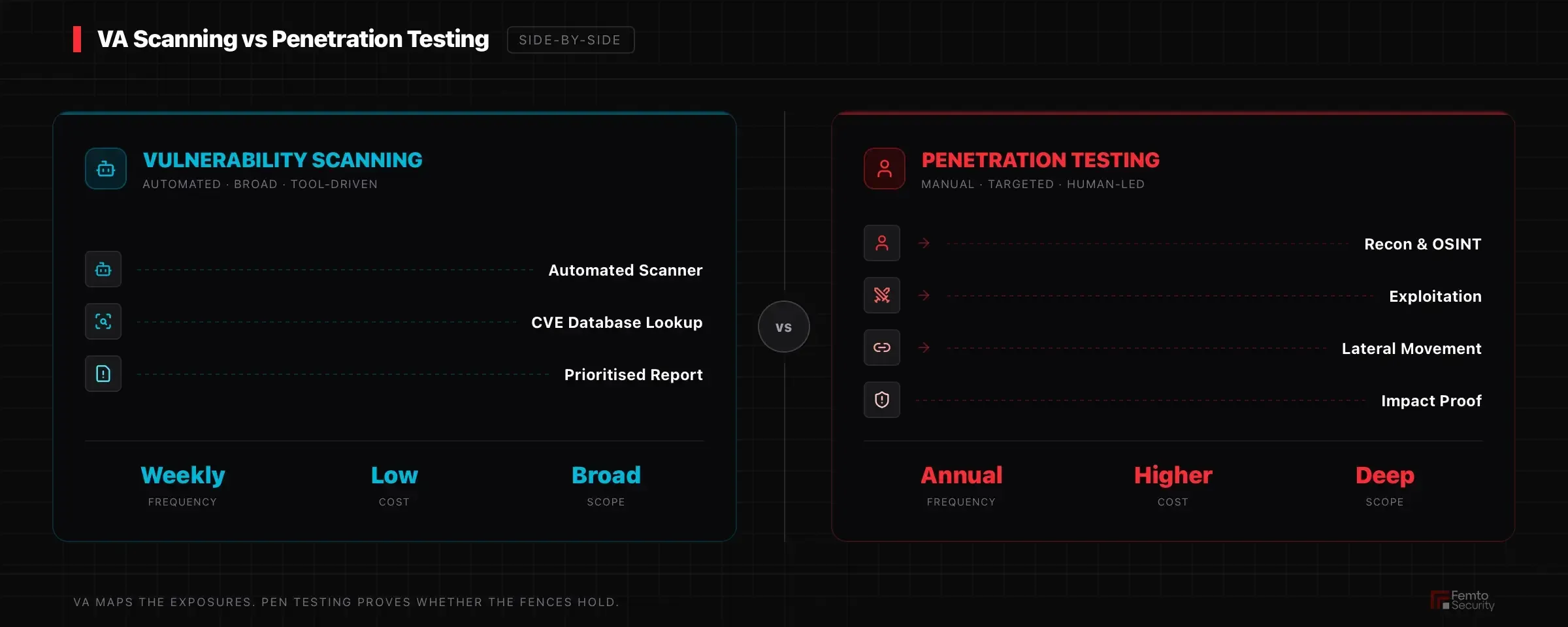
Penetration testing (also known as pen testing or ethical hacking) goes several steps further. Rather than simply identifying weaknesses, a penetration test actively tries to exploit them just as a real-world attacker would. A skilled team of ethical hackers simulates adversarial behaviour to determine whether vulnerabilities can actually be leveraged to breach your systems, exfiltrate data, or move laterally across your network.
What is penetration testing in practical terms? It is a controlled, authorised cyberattack against your own infrastructure. The scope, rules of engagement, and objectives are defined in advance. The output is not just a list of vulnerabilities, but a detailed narrative of how an attacker could chain multiple weaknesses together to cause real damage along with proof-of-concept exploits and remediation guidance.
Femto Security's penetration testing services cover web applications, APIs, networks, cloud infrastructure, and more giving businesses across the UAE the actionable intelligence they need to strengthen their defences before a real threat actor arrives.
Vulnerability Assessment vs Penetration Testing: A Side-by-Side Comparison
To clearly differentiate between vulnerability assessment and penetration testing, the following table outlines the key distinctions across seven critical dimensions:
Feature | Vulnerability Assessment (VA) | Penetration Testing (PT) |
|---|---|---|
Primary Approach | Automated scanning tools | Manual ethical hacking techniques |
Core Goal | Find and rank all known weaknesses | Actively exploit weaknesses to prove impact |
Scope | Broad — entire infrastructure | Targeted — specific systems or applications |
Depth of Analysis | Surface-level inventory of flaws | Deep, narrative-driven attack simulation |
Human Involvement | Minimal — largely tool-driven | High — expert-led, creative methodology |
Frequency | Regular (weekly, monthly, quarterly) | Periodic (annually, post-major change) |
Output | Prioritised vulnerability report | Attack narrative + proof-of-concept + risk impact |
Cost | Relatively low | Relatively higher, reflects expertise |
Regulation Use Case | Compliance hygiene, ongoing monitoring | Regulatory validation (VARA, PCI-DSS, ISO 27001) |
Key insight: Think of vulnerability assessment as building a map of your exposures. Penetration testing is sending an expert to walk that map like an attacker would and report back on exactly how far they got.
Penetration Testing vs Vulnerability Scanning: Clearing Up the Confusion
Many people confuse penetration testing vs vulnerability scanning, and it is easy to see why both involve scrutinising your systems for weaknesses. However, vulnerability scanning is a component of vulnerability assessment, not a substitute for penetration testing.
Vulnerability scanning uses automated tools to query systems and databases of known CVEs (Common Vulnerabilities and Exposures). It is fast, repeatable, and great for maintaining a baseline security hygiene. But it cannot think creatively, chain vulnerabilities together, or assess the business impact of an actual breach.
Penetration testing, by contrast, involves human intelligence. A skilled pen tester may use a combination of attack surface management, open-source intelligence (OSINT), social engineering, and custom exploit development to find what automated tools miss entirely.
If vulnerability scanning is a smoke detector, penetration testing is a trained firefighter checking whether your building would actually hold up in a real fire.
Threat-Led Penetration Testing: The Next Evolution
Threat-led penetration testing (TLPT) is an advanced form of penetration testing that moves beyond standard compliance-driven assessments to simulate the specific tactics, techniques, and procedures (TTPs) of real-world threat actors targeting your industry.
Rather than testing generic attack vectors, threat-led penetration testing is intelligence-driven. It begins with comprehensive threat intelligence gathering to identify which adversary groups are most likely to target your organisation, their preferred entry points, and the typical objectives of these groups. The test is then designed to mirror those actual threat scenarios.
In the UAE, where digital asset exchanges, DeFi platforms, and fintech businesses must meet VARA's stringent cybersecurity requirements, threat-led penetration testing has become a regulatory expectation rather than an optional extra. Femto Security red teaming services take this approach simulating nation-state actors, organised cybercriminal groups, and insider threats to give organisations a genuine measure of their resilience.
TLPT is also increasingly referenced in frameworks such as TIBER-EU (Threat Intelligence-Based Ethical Red Teaming) and is recognised by the European Central Bank as the gold standard for financial sector cyber resilience testing. As Dubai cements its position as a global financial hub, threat-led approaches are rapidly becoming the expectation for serious enterprises.
Key Industry Facts & Statistics
Statistic | Detail | Source |
|---|---|---|
60% | Of organisations that suffered a breach had a known, unpatched vulnerability as the entry point | Ponemon Institute 2024 |
$4.88M | Average cost of a data breach globally in 2024 | IBM Cost of a Data Breach Report 2024 |
206 days | Average time to identify a breach without advanced testing protocols | IBM Security 2024 |
3x | Pen-tested organisations detect breaches 3x faster than those relying on VA alone | Verizon DBIR 2024 |
VARA Mandate | All VARA-licensed VASPs in Dubai required to undergo periodic cybersecurity assessments | VARA Cybersecurity Guidelines 2024 |
When Should You Use Vulnerability Assessment vs Penetration Testing?
One of the most common questions security teams and business leaders ask is: which one do we need right now? The answer depends on your maturity level, regulatory requirements, and risk appetite. In reality, both methodologies are complementary not competing.
Use Vulnerability Assessment When You Need To:
•Establish a security baseline across your entire infrastructure quickly
•Maintain ongoing compliance with frameworks like ISO 27001, VARA, or NCA ECC
•Support regular patch management cycles by identifying new CVEs as they emerge
•Monitor cloud environments, SaaS applications, and third-party systems for continuous risk visibility
•Onboard new assets or post-merger integration to inventory inherited risks
Use Penetration Testing When You Need To:
•Validate that security controls actually work not just that they exist
•Meet regulatory requirements specifying authorised exploitation testing (VARA, PCI-DSS, SWIFT CSP)
•Assess the real-world risk of high-value applications before launch or major updates
•Investigate whether a specific vulnerability is actually exploitable in your environment
•Simulate insider threats or test physical and social engineering resilience
For organisations seeking full-spectrum protection, Femto Security enterprise security solutions integrate both vulnerability assessment and penetration testing into a cohesive, year-round programme tailored to your specific threat landscape.
VARA Compliance and the Role of Security Testing in Dubai's Crypto Ecosystem
Dubai's Virtual Assets Regulatory Authority (VARA) has established one of the world's most comprehensive regulatory frameworks for digital asset businesses. Under VARA's cybersecurity guidelines, Virtual Asset Service Providers (VASPs) are expected to conduct regular, rigorous security assessments and vulnerability assessment vs penetration testing is a distinction that VARA-regulated entities must understand clearly.
VARA's requirements align with global standards such as NIST and ISO 27001, mandating that VASPs demonstrate they have actively tested their security controls—not merely listed their policies. For a detailed breakdown of how these requirements apply to your business, our VARA compliance guide provides a comprehensive walkthrough of the key obligations every crypto business operating in Dubai must meet.
Femto Security's VARA compliance services are specifically designed to help Web3 businesses, digital asset exchanges, and DeFi platforms achieve and maintain compliance. This includes structured penetration testing programmes, threat-led assessments, and ongoing vulnerability management that satisfies VARA's auditing and reporting requirements.
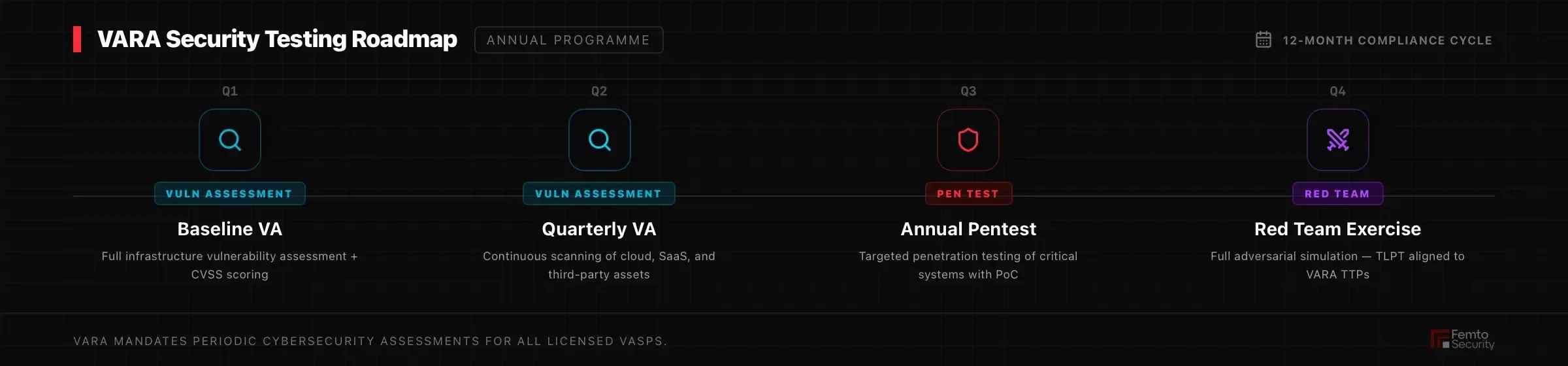
For organisations operating at the intersection of financial services and digital assets, our 2026 VARA strategy guide outlines exactly how to structure your security testing programme to satisfy regulatory expectations while building genuine cyber resilience.
What Do Penetration Testing Companies Actually Do?
When businesses start looking for penetration testing companies, they often encounter a wide spectrum from automated scanning services marketed as 'pen testing' to genuine red team operators with deep offensive security expertise. Understanding what you are paying for matters enormously.
Reputable penetration testing companies will begin with a scoping exercise to define the assets to be tested, the rules of engagement, testing windows, and communication protocols. They will then conduct the assessment using a combination of automated tools and manual techniques, document all findings with evidence, and deliver a report that includes an executive summary, technical detail, proof-of-concept demonstrations, and prioritised remediation guidance.
Some of the most advanced penetration testing companies also offer specialised capabilities such as smart contract auditing for blockchain applications, AI agentic pentesting for AI-powered systems, and source code review for secure development assurance.
At Femto Security, we believe penetration testing is not a checkbox exercise, it is a genuine adversarial simulation that requires creativity, experience, and deep domain knowledge. Our team includes certified offensive security professionals (OSCP, CEH, CREST) with real-world experience across financial services, government, healthcare, and Web3 sectors.
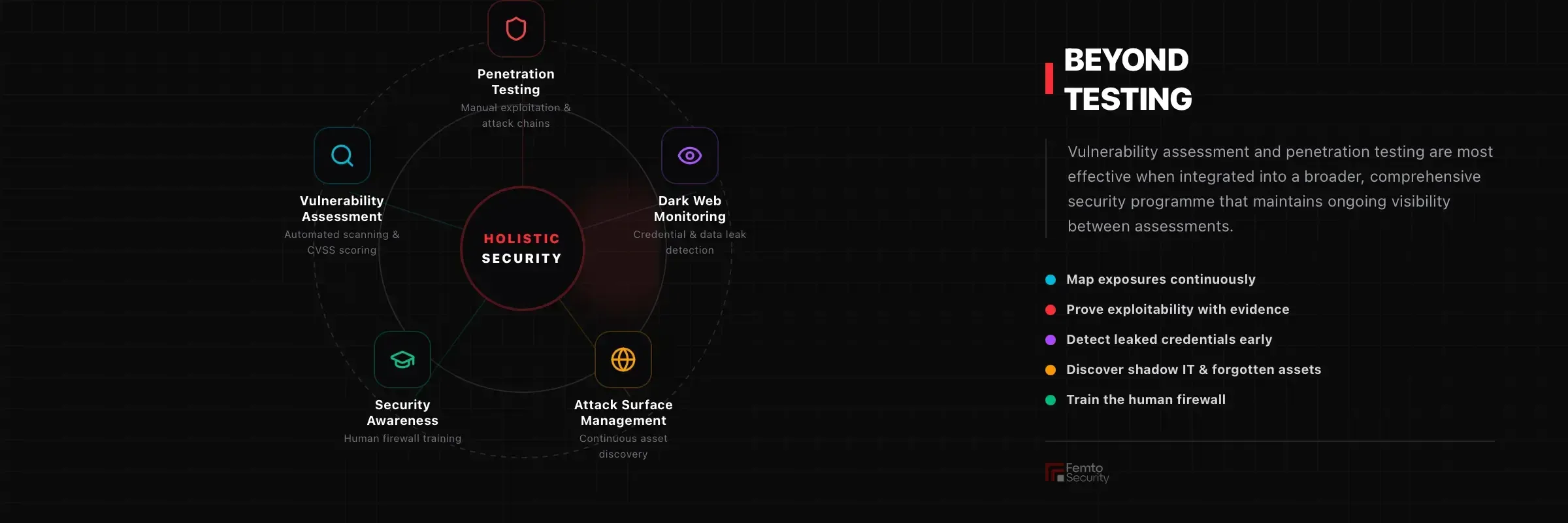
Beyond Testing: Building a Holistic Security Programme
Vulnerability assessment and penetration testing are critical, but they are most effective when integrated into a broader, comprehensive security programme. Knowing your weaknesses and proving they are exploitable is only valuable if you act on the findings and maintain ongoing visibility between assessments.
Femto Security's attack surface management service provides continuous discovery of your internet-facing assets, including shadow IT, forgotten subdomains, and third-party exposures giving your security team the ongoing intelligence they need to stay ahead of attackers.
Our dark web monitoring service adds another critical layer, alerting you when your credentials, sensitive data, or intellectual property appear on underground forums and marketplaces, often the earliest warning of a compromise in progress.
And because technology alone is never enough, our security awareness training programmes equip your employees to recognise and resist social engineering, phishing, and other human-targeted attacks. As we explored in our phishing awareness guide 2026, the human firewall is often both the weakest link and the most cost-effective security investment.
Government and Enterprise Security: Special Considerations
For government entities in the UAE, security testing is more complex. Critical national infrastructure, classified data environments, and citizen-facing digital services all demand the highest standards of assessment rigour. CISA guidelines, UAE's NCA ECC framework, and ADIO directives all emphasise the importance of regular, structured penetration testing programmes for public sector organisations.
Government entities must also consider supply chain security assessing not just their own systems but the security posture of vendors, contractors, and integrated service providers. Femto Security works with government organisations to design security testing programmes that meet national compliance mandates while addressing the unique operational constraints of public sector environments.
Our ISO 27001-aligned approach, detailed in our ISO 27001 UAE guide, provides a strategic framework for government and enterprise organisations to structure their security governance, risk management, and testing programmes in alignment with internationally recognised standards.
How to Choose Between Vulnerability Assessment and Penetration Testing for Your Organisation
Choosing between vulnerability assessment and penetration testing or deciding how to combine them requires an honest assessment of your organisation's current security maturity, regulatory obligations, and risk profile. Here is a practical decision framework:
Scenario | Recommended Approach |
|---|---|
New organisation, no prior security assessment | Start with comprehensive Vulnerability Assessment to establish baseline |
Regulated industry (VARA, PCI-DSS, ISO 27001) | VA for ongoing compliance + Annual Penetration Testing for validation |
Launching a new application or digital product | Application-focused Penetration Testing pre-launch |
Post-breach or suspected compromise | Emergency Penetration Testing + Forensic Investigation |
Mature security programme, high-value assets | Threat-Led Penetration Testing / Red Team Exercise |
Continuous monitoring requirement | VA + Attack Surface Management (ongoing) |
AI or blockchain-based systems | Specialised AI Pentesting or Smart Contract Audit |
The Femto Security Approach: Integrated, Intelligence-Driven Security Testing
At Femto Security, we do not believe in one-size-fits-all security testing. Every organisation faces a unique threat landscape shaped by its industry, geography, technology stack, and regulatory environment. Our approach begins with understanding your business its crown jewels, its risk appetite, and its operational constraints before designing a security testing programme that delivers genuine, measurable improvement.
Whether you need a foundational vulnerability assessment to satisfy compliance requirements, a targeted web application penetration test before a product launch, or a sophisticated threat-led red team exercise to stress-test your incident response capabilities, Femto Security has the expertise and methodology to deliver. Explore our full range of security services or contact our team to discuss your specific requirements.
Femto Security serves enterprises, financial institutions, Web3 businesses, and government entities across the UAE and beyond combining deep technical expertise with an intimate understanding of the regional regulatory landscape.
Conclusion:
The debate between vulnerability assessment and penetration testing ultimately comes down to this: both are essential, and neither can fully replace the other. Vulnerability assessment gives you the map; penetration testing proves whether the fences on that map actually hold. Together, they form the foundation of a credible, defensible, and genuinely resilient cybersecurity programme.
In 2026, as threat actors grow more sophisticated and regulators grow more demanding particularly in the UAE's rapidly evolving digital asset landscape the question is no longer whether to conduct security testing, but how to do so. It is how to do it well, how often, and with whom.
Femto Security is Dubai's trusted partner for comprehensive security testing, VARA compliance, and cyber resilience. Whether you are a blockchain startup navigating your first VARA licensing journey, or an established enterprise seeking to elevate your security maturity, our team is ready to help you build security that works, not just security that looks good on paper.
Frequently Asked Questions (FAQs)
What is the main difference between vulnerability assessment and penetration testing?
A vulnerability assessment identifies and ranks known security weaknesses across your systems using automated tools, without attempting to exploit them. Penetration testing actively exploits those weaknesses, using skilled ethical hackers to demonstrate the real-world impact of attacks. VA gives you a list of problems; PT proves how bad those problems actually are.
What is penetration testing and how does it work?
Penetration testing is a structured, authorised simulation of a cyberattack against your systems. Ethical hackers use the same tools and techniques as malicious actors but within agreed rules of engagement to identify exploitable vulnerabilities, chain attack paths, and demonstrate the potential impact of a real breach. The output is a detailed report with findings, evidence, and remediation guidance.
How often should we conduct vulnerability assessment vs penetration testing?
Vulnerability assessments should be conducted regularly at minimum quarterly, and ideally monthly or continuously using automated tools. Penetration testing is typically conducted annually, after major system changes, before product launches, or when mandated by regulatory requirements such as VARA, PCI-DSS, or ISO 27001.
What is threat-led penetration testing?
Threat-led penetration testing (TLPT) is an intelligence-driven approach where the test scenarios are designed to mirror the specific tactics, techniques, and procedures (TTPs) of real threat actors most likely to target your organisation. It is more sophisticated than standard penetration testing and is increasingly required by financial regulators including VARA for high-value digital asset businesses.
Is penetration testing the same as vulnerability scanning?
No. Vulnerability scanning is an automated process that checks systems against databases of known vulnerabilities it is a component of vulnerability assessment. Penetration testing goes much further, involving human expertise to actively exploit vulnerabilities, chain attack paths, and prove real-world impact. Penetration testing vs vulnerability scanning is similar to the difference between a medical screening and surgery.
Do VARA-regulated businesses in Dubai need penetration testing?
Yes. VARA's cybersecurity framework requires VASPs to conduct regular security assessments that go beyond basic scanning. This includes penetration testing of critical systems and, for higher-risk entities, threat-led exercises. Femto Security specialises in helping digital asset businesses meet these requirements through our VARA compliance and security testing services.
How do I choose a penetration testing company?
Look for certified professionals (OSCP, CEH, CREST), a clear scoping and methodology process, industry-specific experience, and transparent reporting. Avoid companies that deliver only automated scan reports labelled as 'pen tests.' A genuine penetration testing company will provide detailed proof-of-concept evidence, attack narratives, and actionable remediation guidance tailored to your environment.
What does Femto Security offer beyond penetration testing?
Femto Security offers a full spectrum of offensive and defensive security services, including vulnerability assessments, red teaming, attack surface management, dark web monitoring, smart contract auditing, AI-agentic pentesting, source code review, security awareness training, and VARA/ISO 27001 compliance services. Visit our services page to learn more.
Continue Reading
What is zero Trust security removes implicit trust from users and devices. Learn how it works, why UAE enterprises need it, and how to implement it.
Discover what security awareness training is, the topics every program must cover, and how UAE and GCC organizations meet VARA and ISO 27001 requirements.

Complete UAE cybersecurity regulations guide for banks, fintech, govt, crypto: CBUAE, VARA, DESC ISR and ADHICS frameworks explained clearly.