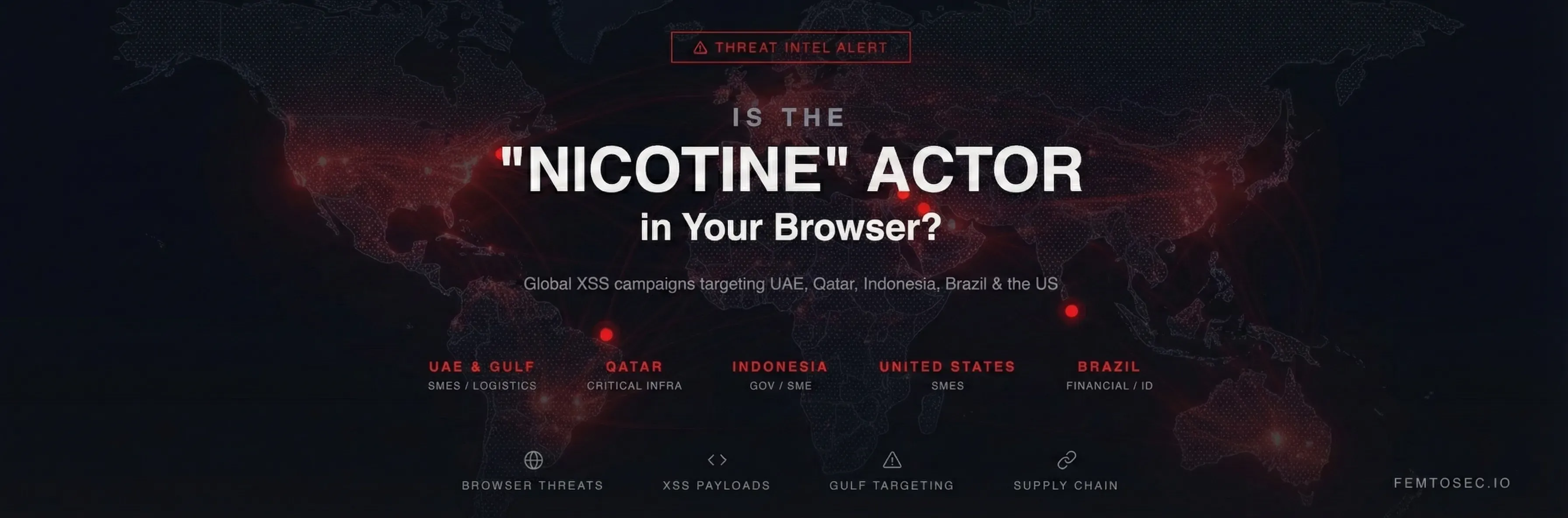
Unmasking "Nicotine": The New Breed of Identity-Based Threat Actors
Unmasking "Nicotine": The New Breed of Identity-Based Threat Actors
In the volatile landscape of the dark web, names rise and fall with the frequency of a heartbeat. However, the actor known as "Nicotine" has recently carved out a specialized niche that every CISO, developer, and Web3 enthusiast needs to monitor.
Moving away from the traditional "smash-and-grab" ransomware tactics, Nicotine represents a sophisticated shift toward Initial Access Brokering (IAB) and targeted Identity Exfiltration.
Who is the Nicotine Threat Actor?
Emerging as a prominent figure on BreachForums and associated Telegram leak channels, Nicotine is not your average script kiddie. Their reputation is built on high-level technical execution and a deep understanding of browser-based vulnerabilities.
While their primary goal is high-value credential theft, Nicotine frequently uses high-profile website defacements as a digital billboard to showcase their capabilities and market their Initial Access services.
Global Impact: Top Affected Countries
Current threat intelligence tracking Nicotine’s defacement campaigns reveals a heavy concentration of activity in specific regions. Notably, there has been a significant recent pivot toward the Gulf region, specifically targeting Small and Medium Enterprises (SMEs).
United Arab Emirates (UAE): A major recent focus area, with increased targeting of SMEs in the logistics, finance, and real estate sectors.
Indonesia: A high-volume target for defacement campaigns, often involving government subdomains.
India: Frequent targeting of educational institutions and local municipal portals.
United States: Focused defacements of SMEs to demonstrate vulnerability in Western infrastructures.
Brazil: A growing theater for Nicotine's financial and identity-harvesting operations.
The Signature "Nicotine-Style" XSS Attack
The most alarming development in their TTPs (Tactics, Techniques, and Procedures) is the "Nicotine-style" Stored XSS. Unlike generic cross-site scripting, this method is surgical.
Modular Payloads: The attack uses "gatekeeper" logic to check for specific session cookies or user IDs, ensuring the malicious lifting only happens when a high-value target is identified.
Advanced Fingerprinting: The script gathers Canvas and WebGL fingerprints to link pseudonymous handles to real-world digital identities.
Web3 Integration: The payload specifically hunts for the
window.ethereumandwindow.solanaobjects, targeting browser-based crypto wallets.
Technical Deep Dive: Detection Engineering
To defend against these sophisticated scripts, SOC teams should implement detection rules targeting the specific execution patterns favored by Nicotine.
1. Detecting Web3 Probing
Regex: /(window\.(ethereum|solana)|window\[['"](ethereum|solana)['"]\])/gi
2. Hunting for Extension IDs
Monitor for requests or script references containing these specific extension IDs:
MetaMask:
nkbihfbeogaeaoehlefnkodbefgpgknnPhantom:
bfnaoomeoheidbhllakndabpbgneabpbCoinbase Wallet:
hnfanknocfeofbddgcijnmhnfnkdnaad
Regex for Log Analysis: /(nkbihfbeogaeaoehlefnkodbefgpgknn|bfnaoomeoheidbhllakndabpbgneabpb|hnfanknocfeofbddgcijnmhnfnkdnaad)/i
3. Identifying Exfiltration Gateways
Regex for Script Analysis: /navigator\.sendBeacon\(.*?\.(top|ru|bit|xyz|pw)\//i
Targeting the Developer Supply Chain
Perhaps the most dangerous pivot in 2026 is Nicotine’s focus on the developer ecosystem. By targeting VS Code extensions and WSL (Windows Subsystem for Linux) environments, they are moving up the supply chain. By exfiltrating ~/.aws/credentials, SSH keys, and GitHub tokens, Nicotine isn't just stealing data-they are stealing the "master keys" to cloud infrastructures.
Protecting Your Organization
Monitor the Dark Web: Identify "luring" chatter before employees click a malicious link.
Hardened Browser Security: Implement strict Content Security Policies (CSP) and consider Browser Isolation for developers.
Credential Hygiene: Move toward identity-based, short-lived tokens.
Conclusion: Vigilance as a Service
As we build nation-wide intelligence tools, it’s clear the perimeter has moved from the firewall to the browser session. Nicotine is just the beginning of a trend where identity is the ultimate prize.
Continue Reading
What is zero Trust security removes implicit trust from users and devices. Learn how it works, why UAE enterprises need it, and how to implement it.
Discover what security awareness training is, the topics every program must cover, and how UAE and GCC organizations meet VARA and ISO 27001 requirements.
Complete UAE cybersecurity regulations guide for banks, fintech, govt, crypto: CBUAE, VARA, DESC ISR and ADHICS frameworks explained clearly.